


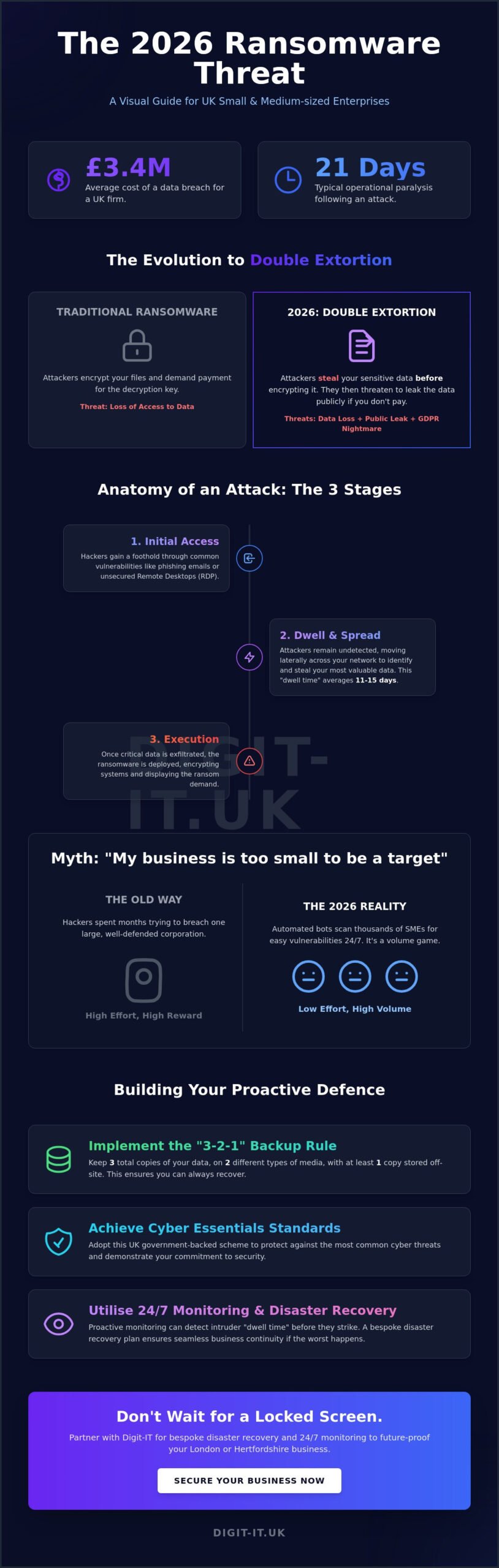
By the start of 2026, the average cost of a data breach for a UK firm has climbed to £3.4 million, yet many owners still find themselves asking what is ransomware only after their screens lock and their files vanish. The true damage isn’t just the financial demand; it’s the 21 days of total operational paralysis that typically follows a successful attack. This loss of momentum can be devastating for growing companies across London and Hertfordshire that rely on constant digital availability.
You probably feel that keeping your business secure is a moving target that is becoming increasingly difficult to hit. It’s exhausting to balance growth with the constant anxiety of a potential cyber attack, especially when technical terms feel designed to confuse rather than clarify. We promise to strip away that complexity. You’ll learn exactly how these threats function and the specific, proactive measures required to safeguard your firm’s future without exhausting your budget.
We’ll examine the current threat landscape and provide a clear, actionable strategy to ensure your business continuity remains uninterrupted and your data stays firmly under your control.
Key Takeaways
- Understand what is ransomware in the 2026 landscape, moving beyond simple encryption to combat sophisticated double extortion schemes that target your sensitive business data.
- Identify the common vulnerabilities hackers exploit during the initial access and lateral movement stages to stop an infection before it spreads across your network.
- Navigate the complexities of ransom demands with insights into the NCSC’s official stance and the significant strategic risks of negotiating within the UK legal framework.
- Implement the “3-2-1” backup rule and Cyber Essentials standards to build a proactive defence that ensures seamless business continuity for your Hertfordshire or London firm.
- Discover how bespoke disaster recovery plans and 24/7 monitoring provide the peace of mind needed to future-proof your operations against evolving digital threats.
Defining Ransomware: The 2026 Threat Landscape for UK SMEs
In simple terms, ransomware is malicious software designed to block access to your computer systems or data until a ransom is paid. While early versions were often random, the 2026 landscape has evolved into a highly professionalised criminal industry. For a comprehensive overview of ransomware and its origins, historical data shows it has moved from a nuisance to a critical operational threat. By 2025, the UK’s National Cyber Security Centre (NCSC) noted that ransomware remained the most significant cyber threat to British businesses. Understanding what is ransomware today requires looking beyond the screen lock and into the theft of your intellectual property.
The Core Mechanism: Encryption vs. Exfiltration
Traditional attacks focused on encryption, where hackers use complex algorithms to lock your files. You’re then offered a decryption key, essentially a digital password, in exchange for payment, often demanded in cryptocurrency. However, 2026 variants almost always include data exfiltration. This double extortion method involves stealing sensitive client information before locking the system. If you refuse to pay for the key, they threaten to leak your private data on the dark web, creating a GDPR nightmare. Ransomware is a business-ending event rather than just a technical glitch.
Why Your Small Business is a High-Value Target
Many directors in Hertfordshire and Buckinghamshire mistakenly believe they’re too small to be noticed. In reality, criminal groups now use automated attack bots to scan for vulnerabilities across the Greater London professional services market. These bots don’t care about your turnover; they look for low-hanging fruit. It’s often more efficient for a criminal syndicate to target 10 small businesses with £50,000 demands than to spend months attempting to breach a single global corporation. Your client data is the primary currency in these transactions.
We’ve seen a distinct shift toward human-operated ransomware. Instead of “spray and pray” emails, attackers now spend time inside a network, identifying the most valuable data to steal. This is why proactive managed IT services are vital; 24/7 monitoring can detect the lateral movement of an intruder weeks before the final encryption happens. You should be aware of these specific trends in the current market:
- Automated Bot Scans: These tools search for unpatched software 24/7, meaning a vulnerability in your office in Watford can be found by a hacker in minutes.
- Sector-Specific Targeting: Attackers now focus on UK supply chains, particularly in the legal and financial sectors where data sensitivity is highest.
- Dwell Time: Hackers often sit silently in your system for an average of 11 to 15 days, mapping your backups before they strike.
Knowing what is ransomware in the current context means recognising that your business is being audited by criminals long before you see a ransom note. By the time the files are locked, the real damage, the theft of your reputation and data, has already occurred.
How Ransomware Infects a Business: The 3 Stages of an Attack
Understanding the lifecycle of a modern cyberattack is the first step toward building true digital resilience. When local directors ask what is ransomware, they often imagine a sudden, unavoidable disaster. In reality, a breach is a methodical three stage process. Today’s threat actors rarely work alone; they often use Ransomware-as-a-Service (RaaS) models. This corporate style structure allows low level criminals to buy sophisticated encryption tools from expert developers, making high quality attacks more frequent for businesses across London and Hertfordshire.
Common Entry Points: Phishing and Unpatched Software
The first stage is initial access. Hackers don’t always need to “break” in; they often just walk through an open door. A single employee in your St Albans or Watford office clicking a deceptive link can compromise your entire firm. These emails often mimic invoices or HR notifications to trick staff. You can see how these look in our guide on what is a phishing email example.
Beyond human error, Remote Desktop Protocol (RDP) remains a primary target. If your RDP isn’t secured with multi factor authentication, it’s essentially a digital skeleton key for intruders. Statistics from 2025 indicate that 74% of successful breaches involved some form of human element or exploited unpatched software. Keeping your systems updated is a non negotiable part of maintaining a secure managed infrastructure.
The Silent Phase: What Happens Before You See the Note?
Once inside, hackers enter the “dwell time” phase. This is the period where they move laterally through your network to identify sensitive data and administrative credentials. They don’t encrypt files immediately. Instead, they spend an average of 11 to 16 days quietly exploring your folders. During this time, they often follow official ransomware guidance by identifying and disabling your backups. If they can delete your safety net, they know you’ll be more likely to pay the demand.
This silent phase is where proactive monitoring becomes invaluable. Our strategic penetration testing identifies these hidden gaps before a hacker can exploit them. By the time the third stage, the payload, occurs, it’s often too late. This is the moment your files turn into unreadable code and the ransom note appears on your screens. Most businesses only realise they have a problem at this final stage, which is why a proactive defence is the only way to ensure total peace of mind.
The Ransom Demand: To Pay or Not to Pay?
Facing a ransom demand is a high-pressure moment for any London business owner. The National Cyber Security Centre (NCSC) and the National Crime Agency (NCA) maintain a firm stance in 2026: do not pay the ransom. While it might feel like the fastest route to business continuity, statistics from 2025 indicate that 80% of organisations that opted to pay were targeted a second time. Paying effectively labels your company as a soft target in criminal databases, inviting future exploitation.
There’s no guarantee of success even after a payment is made. Criminal groups are often disorganized; 46% of UK businesses that paid in the last year failed to recover all their data due to faulty decryption tools. Modern attackers have also moved toward Triple Extortion. They don’t just lock your files; they steal sensitive data and contact your Hertfordshire clients or partners directly to demand separate payments. Understanding how ransomware infects a business is the first step in moving from a reactive mindset to a proactive one. When you grasp what is ransomware and how it operates, you can build the resilience needed to ignore these demands entirely.
The Legal and Insurance Reality in the UK
By 2026, the UK cyber insurance market has become far more rigorous. Most policies now include strict condition precedent clauses. If your business hasn’t maintained its managed infrastructure or failed to achieve Cyber Essentials certification, your insurer might refuse to cover the loss. Beyond the immediate financial hit, the Information Commissioner’s Office (ICO) can levy heavy fines if you’ve failed to protect personal data. Real peace of mind comes from a verified recovery strategy, not a cryptocurrency transfer.
What to Do if You Discover a Ransom Note
If a demand appears on your screen, the Golden Hour is your most critical window. You must isolate affected devices immediately by disconnecting them from the local network and the internet. Document the incident by taking clear photos of the ransom note and report the breach to Action Fraud. Avoid the temptation to clean the systems yourself. Forensic evidence is easily destroyed during DIY attempts, which could invalidate your insurance claim or prevent a successful investigation. Paying a ransom funds further criminal activity and offers zero legal protection.
Proactive Defence: Protecting Your Business in Hertfordshire and London
Ransomware isn’t just a technical glitch; it’s a direct threat to your business continuity. While understanding what is ransomware helps you identify the risk, building resilience requires a structured, proactive strategy. For businesses operating across the busy corridors of Hertfordshire and London, your defence must be layered. We focus on creating a secure environment where technology and human intuition work in tandem to neutralise threats before they escalate.
The single most effective shield against data loss is the 3-2-1 backup rule. This strategy ensures you have three copies of your data, stored on two different types of media, with one copy kept entirely off-site or in an immutable cloud vault. If a breach occurs, this setup allows for rapid recovery without paying a penny to criminals. According to the UK Government’s Cyber Security Breaches Survey 2024, 50% of UK businesses identified a cyber attack in the last 12 months. Having a robust backup is your ultimate safety net.
We also recommend every SME pursues Cyber Essentials certification. This UK standard provides a baseline of security that can prevent up to 80% of common cyber attacks. For remote or hybrid teams in Greater London, implementing a Zero Trust architecture is no longer optional. This model operates on the principle of “never trust, always verify,” ensuring that every device and user attempting to access your network is authenticated, regardless of their location. Finally, your staff must become your human firewall. Regular, engaging training ensures they can spot a sophisticated phishing attempt that automated filters might miss.
Technical Safeguards You Need Today
Implementing Multi-Factor Authentication (MFA) across all business accounts is your first line of defence. Microsoft data indicates that MFA blocks over 99.9% of account compromise attacks. Beyond passwords, you need managed firewall protection and advanced endpoint detection to monitor for unusual patterns in real-time. To build a truly resilient infrastructure, read our comprehensive Cyber Security for Small Business UK pillar article.
The Role of Managed IT Support in Prevention
Proactive monitoring in locations like High Wycombe or Hemel Hempstead allows us to stop attacks in their tracks. Unlike the traditional “break-fix” model, where help is only called after a disaster, a strategic security partnership focuses on 24/7 vigilance. We identify vulnerabilities and patch systems before they can be exploited by those looking for what is ransomware entry points. Explore our full range of managed IT services designed to give SMEs total peace of mind.
Ready to future-proof your infrastructure? Partner with Digit-IT today to secure your business against evolving digital threats.
Building Resilience: The Digit-IT Approach to Ransomware Defence
Protecting your business requires more than just reactive software. It demands a proactive strategy that anticipates threats before they breach your perimeter. Digit-IT provides 24/7 monitoring, acting as a vigilant guardian for your network. We watch your systems so you don’t have to; identifying suspicious patterns that suggest a breach is imminent. By 2026, the question for London firms isn’t just what is ransomware, but how quickly you can neutralise an AI-enhanced attack. Our team serves as your dedicated IT department across London and the Home Counties, providing the technical depth of a global firm with the agility of a local partner.
Resilience is built on bespoke foundations. We don’t believe in generic security packages. Instead, we design backup and disaster recovery plans tailored to your specific operational requirements. Government data from the 2025 Cyber Security Breaches Survey indicated that 70% of medium-sized UK businesses identified a breach; our goal is to ensure you’re in the percentage that recovers without paying a penny. We future-proof your infrastructure against the next generation of threats, including automated, AI-driven exploits that bypass traditional firewalls. Our approach ensures your business continuity remains uninterrupted, regardless of the digital climate.
Why Local Expertise Matters for Cyber Security
Having a security partner who understands the local business landscape in Buckinghamshire offers a distinct strategic advantage. We provide a rapid on-site response for businesses in London and Hertfordshire when every second counts. Remote support is excellent, but some hardware failures or complex breaches require physical intervention. Our team brings a sense of calm authority to technical crises, replacing panic with methodical, expert action. We don’t just fix the problem; we manage the situation so you can focus on your clients.
Your Next Steps Toward Total Security
Securing your assets starts with a clear understanding of your current posture. We guide you through the path to Cyber Essentials certification, a government-backed scheme that can reduce your cyber risk by up to 80%. This isn’t just about a badge; it’s about validating your defences against the most common threats. Understanding what is ransomware helps you appreciate the stakes, but a professional audit reveals the solutions. You can book a free security audit today to identify your specific vulnerabilities and start building a more resilient future.
Don’t leave your business continuity to chance. Secure your business today with a free IT health check.
Secure Your Business Continuity for 2026
The 2026 threat landscape demands more than just basic antivirus software. Understanding what is ransomware today requires a deep dive into AI-driven encryption and multi-stage extortion tactics. With the average recovery cost for UK organisations reaching £800,000 according to Sophos data, success hinges on shifting from reactive recovery to proactive resilience. By implementing Cyber Essentials frameworks and robust immutable backups, you ensure your operations remain seamless even when targeted by sophisticated actors.
Digit-IT brings over 20 years of experience to your doorstep, acting as a strategic partner for businesses across Hertfordshire, Greater London, and Buckinghamshire. Our Cyber Essentials certified practitioners don’t just fix IT issues; we build digital fortresses that allow you to focus on growth without the constant anxiety of a security failure. It’s time to move beyond the fear of the unknown and take control of your digital infrastructure.
Don’t leave your continuity to chance. Book Your Free 2026 Cyber Security Audit with Digit-IT today and gain the peace of mind that comes with professional, local protection.
Frequently Asked Questions
Is ransomware the same as a computer virus?
No, ransomware is a specific category of malicious software rather than a traditional virus. While a virus replicates to corrupt files, ransomware encrypts your data to hold it hostage for a fee. Understanding what is ransomware helps your London business distinguish between simple system bugs and targeted extortion. Modern variants often exfiltrate data before encryption, adding a layer of blackmail to the initial attack.
Can my business be targeted if we use cloud storage like Google Drive or OneDrive?
Your cloud storage isn’t a magic shield against infection. If a local device gets hit, the synchronisation feature in Google Drive or OneDrive can instantly upload encrypted files to the cloud. This overwrites your clean versions. Sophisticated attackers also target cloud administrative credentials. We recommend implementing immutable backups that can’t be altered by automated sync processes to ensure your Hertfordshire office remains resilient.
How much does a typical ransomware attack cost a UK small business?
The average cost of recovery for a UK small business reached £71,240 in 2023 according to industry data from Hiscox. This figure includes more than just the ransom. You must account for lost revenue during downtime, forensic investigations, and mandatory data breach reporting fees. For a firm in London, the reputational damage often outweighs the immediate financial loss, making proactive managed infrastructure a vital investment.
If I have an antivirus, am I fully protected against ransomware?
Standard antivirus software alone doesn’t provide total security against the evolving threat of what is ransomware today. Modern threats use zero-day exploits that haven’t been catalogued yet, allowing them to bypass traditional signature-based detection. You need a multi-layered strategy that includes Endpoint Detection and Response (EDR) and regular staff training. Our approach focuses on building digital resilience so your business can detect suspicious behaviour proactively.
What is the first thing I should do if I think my office network is infected?
Disconnect the affected device from your network and the internet immediately. You should physically unplug the ethernet cable or turn off the Wi-Fi to stop the infection from spreading to other servers. Don’t restart the computer, as this can trigger further encryption or delete vital forensic evidence. Once the device is isolated, contact your IT partner to begin your incident response plan and secure your remaining infrastructure.
Can ransomware spread through my business VoIP phone system?
Ransomware can move through any part of your network, including your VoIP system, if it’s not properly segmented. Many modern phone systems run on standard servers or integrated computers that are vulnerable to the same exploits as your workstations. If an attacker gains administrative access, they can disrupt your communications or use the VoIP hardware as a bridge to reach other sensitive business data stored on your network.
How often should our business backups be tested to ensure they work?
You should perform full restoration tests at least once every quarter. Simply seeing a backup successful notification isn’t enough to guarantee your data is recoverable. In 2024, the Cyber Security Breaches Survey found that regular testing significantly reduces recovery time. We help Hertfordshire firms implement automated testing schedules to ensure their backups are viable and ready to restore operations within minutes of a technical failure.
Is it illegal to pay a ransom in the UK?
Paying a ransom isn’t currently illegal under UK law, but the government and the National Cyber Security Centre (NCSC) strongly advise against it. You might also accidentally breach international sanctions if the payment goes to a prohibited group. Paying doesn’t guarantee you’ll get your data back. In fact, 80 percent of organisations that pay suffer a second attack shortly after, often from the same criminal group.

