
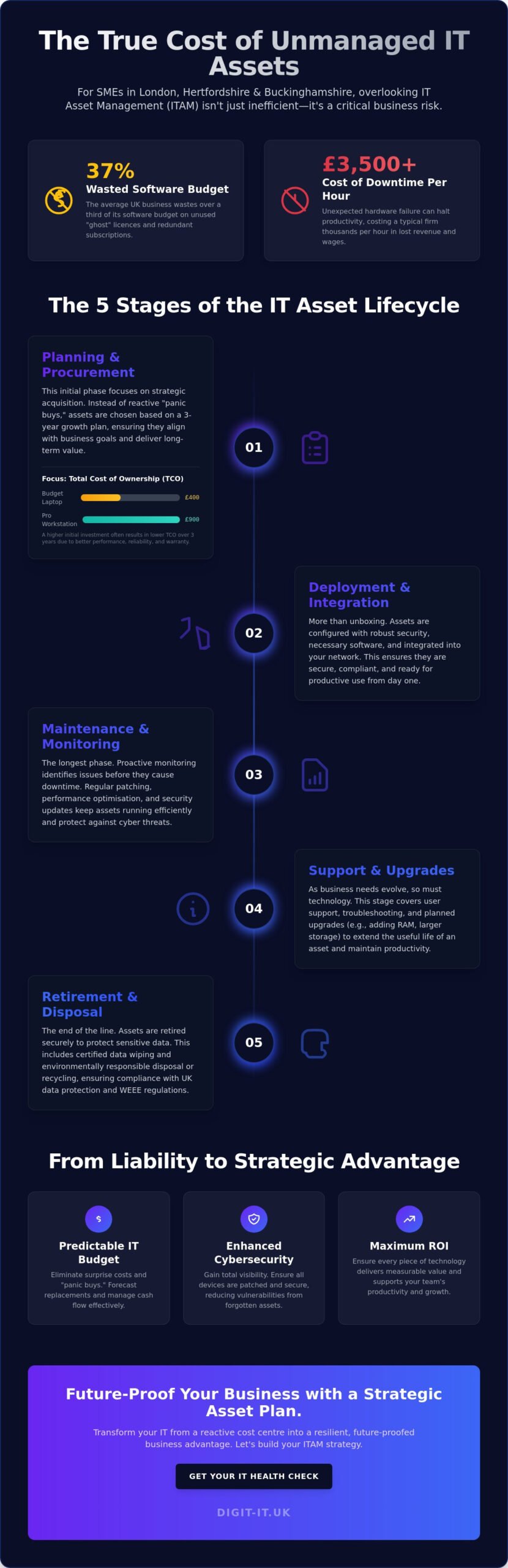
Did you know that the average UK business wastes up to 37% of its software budget on licences that no one actually uses? For SMEs across Hertfordshire, London, and Buckinghamshire, these hidden inefficiencies do more than just drain your bank account. They create significant security vulnerabilities through unpatched, forgotten devices. Implementing a robust strategy for it asset management isn’t just about keeping a simple list of laptops. It’s about gaining total visibility over your digital landscape to prevent unexpected hardware failures that can cost a firm over £3,500 per hour in lost productivity.
You likely feel that your technology should be a catalyst for growth rather than a source of financial surprise. We agree that your IT budget belongs in your business, not lost to “ghost” assets or redundant subscriptions. This article explains how strategic oversight protects your business continuity and optimises technology investments across the Home Counties. We’ll examine the specific steps to achieve a predictable IT budget, improve your cybersecurity posture, and ensure every piece of kit delivers a measurable return on investment for your team.
Key Takeaways
- Understand how proactive it asset management serves as a strategic foundation for SMEs in London and Hertfordshire to ensure long-term business resilience.
- Identify how a lifecycle-based approach prevents costly “panic-buy” hardware failures while significantly improving the return on your technology investments.
- Master the dual focus required to manage physical and digital assets effectively, addressing the unique infrastructure challenges of local office environments.
- Follow a manageable roadmap to implement a robust asset strategy within your organisation, starting with small, high-impact steps that protect your daily operations.
- See how professional monitoring and strategic oversight can transform your IT estate from a potential liability into a future-proofed business advantage.
What is IT Asset Management (ITAM) for Small Businesses?
For small and medium enterprises across London and Hertfordshire, technology is the engine of growth. However, many business owners mistake a basic inventory list for a comprehensive strategy. True What is IT Asset Management (ITAM) involves a proactive lifecycle approach that tracks, manages, and optimises every piece of hardware and software within your organisation. It’s a strategic framework designed to ensure your digital tools deliver maximum value while minimising operational risks.
In a competitive market like the Home Counties, efficiency isn’t just a goal; it’s a necessity for survival. Strategic it asset management transforms IT from a reactive cost centre into a resilient pillar of business continuity. It moves beyond knowing you have twenty laptops. It focuses on how those laptops are performing, when they need replacing, and if they’re currently exposing your business to security threats. By treating technology as a high-value investment rather than a recurring expense, you create a foundation for long-term stability.
The difference between “just having a list” and strategic management is the difference between being reactive and being in control. A list tells you what you bought in 2023. Strategic ITAM tells you that a specific server in your St Albans office is nearing its end-of-life and needs a phased replacement before it fails. This foresight allows for better cash flow management and prevents the frantic, expensive “emergency fixes” that disrupt productivity.
The Core Components of a Modern ITAM Strategy
Effective management rests on three pillars. First, inventory management ensures you have total visibility of your hardware and software footprint. Second, financial tracking monitors procurement costs and depreciation, helping you avoid the “tech debt” that often plagues growing firms. Finally, risk management identifies security vulnerabilities in aging assets. By addressing these areas, you ensure your managed infrastructure remains robust, cost-effective, and aligned with your broader commercial goals.
Why ITAM Matters in 2026
The business environment in Greater London has shifted permanently toward hybrid working. This transition makes device tracking more complex than ever. Without a structured it asset management programme, equipment often goes missing or stays unpatched in home offices. Additionally, UK data protection standards and GDPR require strict control over where data resides. Well-managed assets act as a first line of defence, strengthening your overall cybersecurity posture and ensuring your business remains compliant, secure, and future-proof in an increasingly digital economy.
The 5 Key Stages of the IT Asset Lifecycle
Effective it asset management isn’t a reactive task; it’s a strategic cycle that ensures your technology delivers maximum ROI. SMEs in London and the Home Counties often fall into the “panic-buy” trap. This happens when a critical hardware failure leads to an emergency purchase of whatever is available at the nearest retailer. These rushed decisions lead to fragmented systems, security gaps, and higher long-term costs. By following a structured lifecycle approach, you ensure every device serves your business goals from the moment it’s conceived to the second it’s recycled.
A proactive strategy prevents technical debt from accumulating. It transforms your IT estate from a collection of expensive headaches into a streamlined engine for growth. This methodology relies on five distinct phases that govern the life of every piece of hardware and software in your organisation.
1. Strategic Planning and Procurement
Procurement starts with analysis, not a credit card. We evaluate the Total Cost of Ownership (TCO) rather than just the initial price tag. A budget laptop costing £400 might seem attractive, but when you factor in limited 12-month warranties and lower performance specs, the true cost over three years often exceeds that of a £900 professional workstation. Our IT consultancy services help you source reliable hardware that matches your three-year growth plan. This ensures your infrastructure scales seamlessly without requiring constant, piecemeal upgrades.
2. Deployment and Active Management
Once an asset arrives, it enters the deployment phase. This involves more than just unboxing and handing over a password. We configure every device with robust security protocols and integrate them into your managed IT support framework from day one. This proactive oversight means we monitor performance metrics in real-time. We can catch a failing battery or a storage bottleneck before it results in a lost afternoon of productivity for your team. This stage is where it asset management delivers its most tangible value by maintaining peak performance.
3. Maintenance, Retirement, and Secure Disposal
Every device eventually reaches a “tipping point.” This is the moment where the cost of patches, emergency repairs, and lost billable hours outweighs the price of a replacement. Following The 5 Key Stages of the IT Asset Lifecycle helps your business recognise this threshold before it becomes a crisis. When an asset reaches its end-of-life, secure disposal is non-negotiable. We handle certified data wiping to meet UK GDPR standards and ensure all hardware is recycled under WEEE regulations. This protects your data, your reputation, and the environment.
If you’re unsure whether your current hardware is a liability or a strategic asset, contact us for a strategic review to audit your digital estate.
Hardware vs. Software Asset Management: A Dual Focus
Effective IT asset management (ITAM) isn’t a one-size-fits-all process because physical and digital assets age and fail in entirely different ways. While a server in a London office might fail due to hardware fatigue or poor ventilation, a software license becomes a liability through obsolescence or over-provisioning. Bridging this gap is essential for maintaining a robust cyber security for small business UK strategy. Data from 2023 shows that 43% of cyber attacks target SMEs that rely on unpatched or unmonitored assets, making the dual focus on hardware and software a necessity rather than an option.
Maximising ROI with Hardware Asset Management
Managing hardware for a distributed workforce requires logistical precision. SMEs in Hertfordshire and Buckinghamshire often struggle with the logistics of retrieving equipment from remote staff or deploying new VoIP hardware across multiple sites. Proactive hardware support ensures that laptops aren’t just tracked by serial number, but also by their battery health and warranty status. For London-based firms, where office space is at a premium, moving away from bulky on-premise servers to streamlined, managed infrastructure reduces cooling costs and physical risk. This proactive lifecycle management can extend the use of a standard business laptop from three years to five, saving a 25-person firm approximately £5,000 in premature replacement costs.
Optimising Your Software and Cloud Subscriptions
Software bloat is a silent profit killer that creeps into the monthly balance sheet. Recent UK industry data suggests that small businesses waste up to 30% of their software budget on unused or redundant SaaS subscriptions. Regular audits of Microsoft 365 environments often reveal accounts for former employees that are still active, costing the business hundreds of pounds annually. Beyond the financial drain, “shadow IT” poses a massive risk. When an employee in a St Albans office uses an unapproved cloud storage tool because the corporate version feels slow, your sensitive data leaves the protected perimeter. Consolidating these subscriptions into a managed, single-sign-on environment improves data security and slashes unnecessary overhead. This level of it asset management ensures you only pay for the tools your team actually uses to drive growth.
Implementing ITAM in Hertfordshire and London: A Practical Checklist
Starting an it asset management journey doesn’t require a total departmental overhaul overnight. Most SMEs in the South East find success by phasing in controls, beginning with high-value hardware before moving to software licenses. Your strategic IT consultant acts as the architect here, ensuring your roadmap aligns with long-term business goals rather than just ticking boxes. This phased approach prevents operational bottlenecks and allows your team to adapt to new workflows gradually.
Step 1: Audit and Centralise Your Asset Data
You can’t manage what you can’t see. The first task is identifying every laptop, server, and mobile device across your London or Hertfordshire offices. A Single Source of Truth is the centralised, definitive record of every hardware and software asset within your organisation. This database provides the foundation for all future decisions. To be effective, your audit should capture:
- Purchase dates and original costs in GBP.
- Warranty expiration timelines and support contract details.
- Current user assignments and physical office locations.
Automation plays a vital role in this stage. Modern discovery tools scan your network to populate this list automatically, which typically removes the 25% error rate associated with manual spreadsheets. This ensures your data remains accurate even as employees join or leave the company.
Step 2: Define Policies for Procurement and Disposal
Efficiency relies on consistency. Establish clear rules for who can request new tech and who holds the budget for approval. Standardising your hardware, such as sticking to specific business-grade Dell or Lenovo models, simplifies future support and reduces the variety of spare parts you need to stock. It also makes it easier for your IT partner to provide seamless maintenance.
For disposal, your policy must be watertight to protect your reputation. UK businesses must comply with the Waste Electrical and Electronic Equipment (WEEE) Regulations 2013. Ensure every retired hard drive is physically destroyed or wiped using industry-standard software. You should always keep certificates of destruction on file to prove compliance during any future data audits.
Step 3: Continuous Monitoring and Review
Asset management is a living process, not a one-off project. Schedule quarterly reviews to identify underused resources that are draining your budget. For instance, a London-based team member might have left three months ago, yet their expensive software subscription could still be active. Using managed IT services allows you to automate health checks, alerting you before a server reaches its end-of-life or a laptop battery begins to fail. This proactive stance ensures your infrastructure remains resilient as you scale across the South East.
Future-Proofing Your Business with Digit-IT Asset Strategy
Moving beyond the “break-fix” cycle is the first step toward true operational resilience. Effective it asset management isn’t just about keeping track of laptops or monitoring license renewals; it’s about ensuring every piece of hardware and software contributes directly to your bottom line. Digit-IT acts as your strategic partner, turning technical overhead into a competitive edge. We look beyond the next quarter to ensure your infrastructure scales alongside your ambitions, providing a clear roadmap for every device in your fleet.
Our proactive monitoring identifies hardware fatigue before it causes a system crash. Research from the Ponemon Institute suggests that unplanned downtime can cost small businesses an average of £3,000 per hour. We prevent these financial leaks by maintaining a rigorous lifecycle plan. This ensures you aren’t caught off guard by end-of-life cycles or sudden security vulnerabilities. By transitioning from reactive fixes to a managed strategy, you gain the “peace of mind” that comes from knowing your tech is handled by experts.
Our Bespoke Approach to SME Asset Management
We understand that a creative agency in Buckinghamshire has different technical requirements than a financial consultancy in London. Our team delivers tailored it asset management strategies that align with your specific industry regulations and growth targets. We don’t believe in one-size-fits-all solutions. Instead, we integrate your inventory oversight with our robust data backup and recovery services to create a unified safety net for your business data.
- Local Expertise: Deep understanding of the business environments in Hertfordshire, London, and Buckinghamshire.
- Total Integration: Syncing asset tracking with cybersecurity protocols and backup schedules.
- 24/7 Technical Support: Constant oversight to ensure maximum uptime and immediate resolution of hardware issues.
- Lifecycle Optimization: Extending the usable life of assets by 15% through regular maintenance and performance tuning.
Take the First Step Toward a Resilient IT Infrastructure
The transition to professional oversight is seamless. When you partner with us, you’re gaining a Trusted Advisor dedicated to your long-term success. We bridge the gap between human talent and digital tools, ensuring your team has the reliable equipment they need to excel. This strategic oversight alleviates the anxieties associated with technical failures, allowing you to focus on business growth and stability.
Don’t wait for a hardware failure to disrupt your operations. Book a strategic consultation today to review your current inventory and identify opportunities for optimization. Explore our full range of managed IT services to see how we can strengthen your digital foundation. Let’s build a tech roadmap that secures your business’s future today.
Transform Your Technology into a Strategic Growth Engine
Effective it asset management is no longer a luxury for SMEs; it’s a fundamental requirement for operational resilience. By mastering the five stages of the asset lifecycle and balancing hardware and software needs, you eliminate the hidden costs of ghost assets and outdated licenses. Businesses across London and Hertfordshire are finding that a structured approach to digital tools provides the clarity needed for smarter procurement and tighter security. It’s about turning your technical infrastructure from a cost center into a competitive advantage.
Digit-IT brings over 20 years of experience supporting UK SMEs through every technical challenge. We don’t just fix problems; we prevent them through proactive 24/7 technical monitoring and bespoke strategy. As your dedicated partner, we ensure your business remains agile in an evolving market. Our team acts as a seamless extension of your own, providing the calm authority and technical precision required to future-proof your operations. You deserve the peace of mind that comes with knowing your digital estate is optimised and secure.
Optimise your business technology with Digit-IT today
Let’s work together to build a more efficient, resilient future for your business.
Frequently Asked Questions
Is IT asset management necessary for a business with only 10 employees?
Yes, it’s essential because even a small team of 10 manages approximately 30 to 50 individual assets including laptops, mobiles, and software licenses. Without formal it asset management, your business risks 15% higher hardware costs due to over-provisioning. We ensure your small team remains agile by tracking every device from procurement to disposal. This prevents security gaps that lead to data breaches in 43% of UK small businesses.
How much does IT asset management software cost for a UK small business?
Professional ITAM software typically starts from £2 to £5 per asset monthly for cloud-based platforms. For a business with 25 devices, this represents a modest investment of £50 to £125 per month. According to industry reports from Gartner, implementing these tools can reduce IT spending by up to 30% in the first year. We help you select a platform that scales with your growth across Hertfordshire and London.
Can ITAM help my business pass a cyber security audit?
Yes, formal asset management is a core requirement for achieving the UK Government’s Cyber Essentials certification. You can’t protect what you can’t see. Our approach provides the documented evidence of patch levels and encryption status required by auditors. By maintaining an accurate inventory, 90% of the preparation for a security audit is already complete. This ensures your business meets the stringent standards required by London’s financial and legal sectors.
What is the difference between ITAM and simple inventory tracking?
Inventory tracking is a static list of what you own, while it asset management is a strategic lifecycle process. ITAM tracks financial data, contract expirations, and real-time performance metrics rather than just serial numbers. This distinction allows us to predict when a server will fail or when a software license is due for renewal. It transforms a simple spreadsheet into a proactive tool that drives business continuity and financial efficiency.
How often should we conduct a full IT asset audit?
You should conduct a comprehensive physical audit at least once every 12 months. However, for businesses in fast-moving sectors across Buckinghamshire, we recommend a bi-annual review to account for rapid staff turnover or hardware upgrades. Regular audits reduce ghost assets, which account for up to 10% of IT inventory in many UK firms. This schedule ensures your balance sheet remains accurate and your security software covers every active device.
Does ITAM include managing cloud-based services like Microsoft 365?
Yes, modern asset management must include your cloud-based SaaS subscriptions like Microsoft 365 and Adobe Creative Cloud. We track these virtual assets to ensure you aren’t paying for zombie licenses assigned to former employees. Industry data suggests that UK SMEs waste approximately £2,500 per year on unused cloud subscriptions. Our proactive monitoring ensures your digital infrastructure is as lean and cost-effective as your physical hardware.
What happens if we do not have a formal IT asset disposal policy?
Lacking a formal disposal policy exposes your business to GDPR fines reaching £17.5 million or 4% of global turnover. Beyond legal risks, improper disposal of hardware leads to environmental non-compliance under UK WEEE regulations. We provide a secure chain of custody and data destruction certificates for every retired device. This protects your reputation and ensures that sensitive client data never leaves your control on a discarded hard drive.
Can an outsourced IT support company handle our asset management?
Yes, partnering with a managed service provider is the most efficient way to maintain your asset register. We act as your strategic partner, using professional monitoring tools to track your hardware and software 24/7. This allows your internal team to focus on growth while we handle the technical lifecycle. We provide the expertise needed to future-proof your infrastructure across the Home Counties, ensuring your technology always supports your business goals.

