
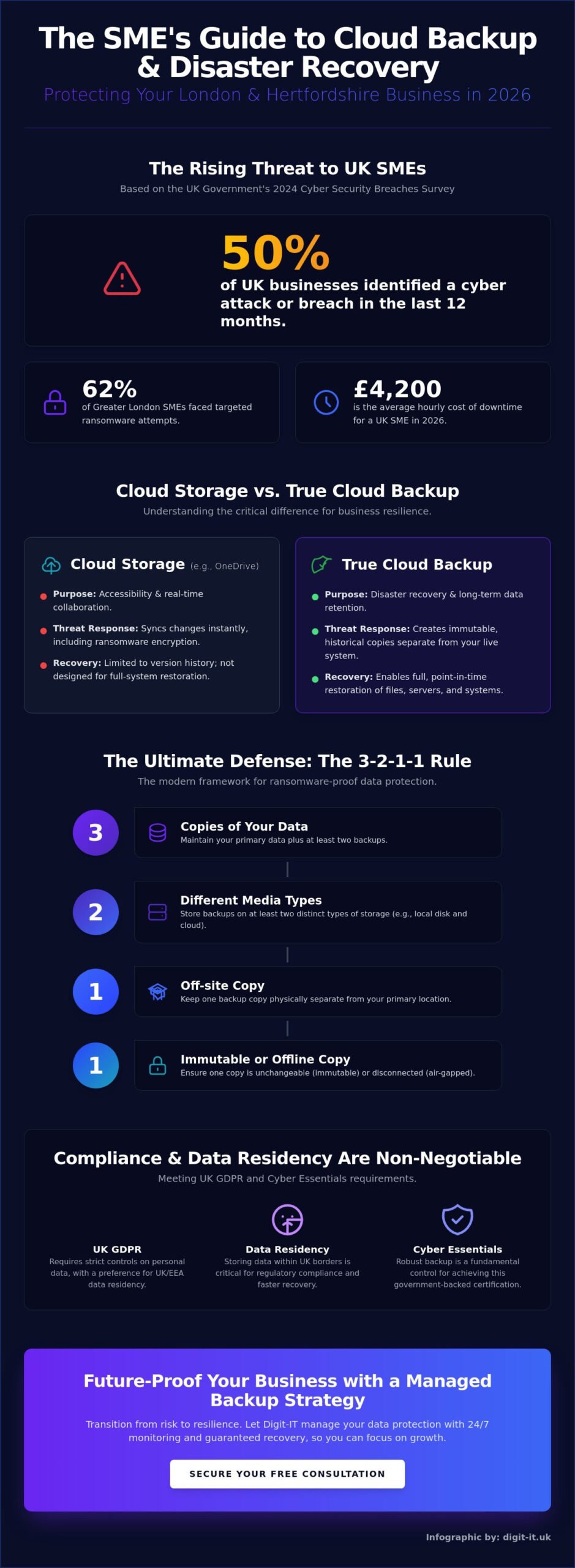
A staggering 50% of UK businesses identified a cyber attack or breach in the last 12 months, according to the government’s Cyber Security Breaches Survey 2024. For a growing SME in London or Hertfordshire, this isn’t just a statistic; it’s a direct threat to your operational continuity. You likely feel the weight of protecting sensitive client data while trying to decode complex GDPR requirements. It’s a common frustration to find your team’s productivity stalled by manual processes or the nagging fear that a single incident could lead to permanent data loss.
We believe your technology should simply work, serving as a silent, resilient partner to your growth. You deserve the peace of mind that comes from knowing your files are recoverable in minutes, not days, without requiring constant manual oversight. This 2026 comparison explores the most robust cloud backup solutions for business to future-proof your infrastructure across London, Hertfordshire, and Buckinghamshire. We’ll examine how to achieve seamless compliance and technical excellence, ensuring your digital assets remain secure while you focus on high-level strategy.
Key Takeaways
- Learn why a robust cloud backup strategy is the ultimate defense against the rising tide of ransomware targeting SMEs across London and the Home Counties.
- Compare the most resilient cloud backup solutions for business in 2026, moving beyond simple file storage to comprehensive disaster recovery architectures.
- Master the “3-2-1-1” backup rule to ensure your data remains immutable, off-site, and recoverable regardless of the failure scenario.
- Navigate UK GDPR and Cyber Essentials requirements by understanding why data residency and server location are critical for local regulatory compliance.
- Discover how transitioning from a “set and forget” DIY approach to a managed, proactive partnership can future-proof your business operations.
Why Cloud Backup Solutions are Critical for London and Hertfordshire Businesses in 2026
Securing your digital assets is no longer a back-office task; it’s a strategic imperative. For SMEs across London and Hertfordshire, cloud backup solutions for business provide an automated, off-site data protection strategy that moves beyond simple file saving. This proactive approach ensures that your critical data resides in a secure, encrypted environment, physically separated from your local infrastructure. By removing the human element from the backup process, you eliminate the risk of manual error and ensure that your data is always current and recoverable. In 2026, resilience isn’t just about survival. It’s a competitive advantage that signals reliability to your clients and partners.
Cloud Storage vs. Cloud Backup: The Vital Difference
Many business owners confuse collaboration tools with disaster recovery. While platforms like OneDrive are excellent for daily teamwork, they don’t offer total recovery. Understanding Cloud Backup reveals that true backup creates immutable copies of data, whereas storage simply mirrors changes. If a virus encrypts a file, it syncs across all devices instantly. Dedicated Data Backup and Recovery services eliminate this risk by maintaining historical versions. Key differences include:
- Storage: Focuses on accessibility, syncing, and real-time collaboration.
- Backup: Focuses on long-term retention, encryption, and disaster recovery.
The Local Threat Landscape in 2026
Digital risks for firms in Buckinghamshire and Hertfordshire have intensified. Recent data shows that 62% of SMEs in the Greater London area faced targeted ransomware attempts in the last year. The average cost of downtime for a UK SME in 2026 has reached £4,200 per hour when lost productivity and reputational damage are factored in. High-speed ‘Gigabit London’ connectivity now makes cloud backup solutions for business faster and more viable than ever, allowing for high-volume data transfers in minutes rather than hours.
Business resilience has evolved into a significant competitive advantage for local firms. Companies that can demonstrate a robust recovery plan often find it easier to secure insurance and win contracts with larger partners who demand strict data security. Our team at Digit-IT focuses on delivering managed IT services that integrate these backup protocols into your broader business strategy. This approach transforms IT from a potential point of failure into a foundation for growth, providing the peace of mind needed to focus on your core operations.
Understanding Cloud Backup Architectures: From File-Level to Disaster Recovery
Modern cloud backup solutions for business aren’t just about saving copies of spreadsheets. They’re the foundation of operational resilience. In 2026, the landscape of data protection has shifted from simple storage to complex, multi-layered architectures designed to withstand sophisticated cyber threats. We view backup as the cornerstone of a proactive Managed IT Support London strategy, ensuring that a local hardware failure or a regional outage doesn’t result in permanent data loss.
To achieve true security, we implement the 3-2-1-1 rule. This evolved framework requires three copies of your data on two different types of media, with one copy stored offsite and one copy kept in an immutable state. Immutability is your ultimate safeguard against ransomware. It creates a digital vault where data cannot be changed, deleted, or encrypted by external actors for a set period. Following the NCSC’s Small Business Guide ensures that your first line of defence is built on government-backed best practices, which reported that 50% of UK businesses experienced a cyber attack in 2024.
File-Level vs. Image-Based Backup
Choosing the right backup type depends on what you need to recover and how fast you need it back. File-level backup is a lightweight approach. It’s ideal for protecting specific documents, PDFs, and folders. It’s efficient for businesses with limited bandwidth but lacks the ability to restore entire systems quickly.
Image-based backup captures a block-level “snapshot” of your entire server environment, including the operating system, applications, and configurations. If a server in your Hertfordshire office fails, an image-based solution allows us to spin up a virtual version of that machine in the cloud almost instantly. This approach is essential for businesses that cannot afford the hours or days it takes to manually reinstall software and reconfigure settings.
Recovery Time (RTO) vs. Recovery Point (RPO)
Understanding your tolerance for downtime requires a clear definition of two metrics:
- Recovery Time Objective (RTO): This is the duration of time a business process must be restored after a disaster. For a London law firm, an RTO of 4 hours might be the limit before client trust is compromised.
- Recovery Point Objective (RPO): This defines the maximum age of files that must be recovered. It dictates how much data you’re willing to lose.
In 2026, cloud technologies allow for near-zero RPO. For critical London financial firms, we can implement continuous data protection that syncs every few minutes, ensuring that even a mid-day system crash only results in a negligible loss of data. If you’re unsure where your current infrastructure stands, exploring our comprehensive IT services can provide the clarity your board requires to stay protected.
Comparing the Best Cloud Backup Solutions for UK SMEs: DIY vs. Managed
Choosing the right cloud backup solutions for business involves more than just picking a brand name. You’re deciding between a tool you manage yourself and a partnership that guarantees results. In 2026, the gap between “set and forget” DIY software and professional managed services has widened, especially as cyber threats become more sophisticated.
Top DIY Cloud Backup Platforms
- Acronis Cyber Protect: This is a powerhouse for firms needing integrated security. It doesn’t just copy files; it uses AI-based behavioural detection to stop ransomware in its tracks, making it ideal for London businesses with high security requirements.
- Backblaze: This remains the most cost-effective way to protect remote teams. It offers simple, unlimited workstation backup for a flat monthly fee, which helps small teams in Hertfordshire keep their budgets predictable.
- Veeam: Often considered the gold standard, Veeam is built for virtualised environments and Microsoft 365. It provides the granular recovery options that growing businesses need when they can’t afford even an hour of downtime.
When evaluating these platforms, you’ll often choose between “Unlimited” storage and performance-based plans. While unlimited plans look attractive on a balance sheet, they often come with slower upload speeds. Performance-based plans are designed for speed, ensuring that a 500GB database recovery doesn’t take three days to download over a standard office connection.
The Managed Service Advantage
Digit-IT transforms backup from a technical chore into a business resilience strategy. Implementing robust cloud backup solutions for business requires constant vigilance. We monitor your backup success 24/7, removing the administrative burden from the business owner. If a backup fails at 2 AM in a Watford office, our team is alerted immediately, often resolving the issue before your staff logs on at 9 AM.
The most critical difference lies in “Restore Testing.” Industry data suggests that roughly 20% of data restores fail because of silent corruption or configuration errors. DIY users frequently skip this step because it’s time-consuming. We perform regular, documented restore tests to ensure your data is actually recoverable when a crisis hits. This proactive approach turns a “hopeful” backup into a guaranteed recovery point.
Our Strategic IT Consultancy helps you design a bespoke backup architecture that aligns with your specific growth goals. Having a local Hertfordshire expert to call during a data crisis is invaluable. You won’t be stuck in a global support queue; you’ll have a dedicated partner who understands your infrastructure and is committed to your long-term success.
Compliance and Security: GDPR and Cyber Essentials in the Cloud
Compliance isn’t a box-ticking exercise for London SMEs; it’s a strategic safeguard. Under UK GDPR, your business is legally responsible for the availability and access to personal data in a timely manner following a physical or technical incident. Failing this can lead to Information Commissioner’s Office (ICO) fines that reach up to £17.5 million or 4% of global turnover. Professional cloud backup solutions for business mitigate this risk by providing a resilient, encrypted safety net. We implement AES-256 encryption protocols that secure your data at rest and in transit. This ensures that your proprietary information remains your own, shielded by the same standards used by global financial institutions.
We believe technology is only as good as the strategy behind it. A robust backup plan doesn’t just save files; it preserves your reputation. By automating the backup process, you eliminate human error, which remains the leading cause of data loss in the UK. This proactive approach transforms a potential disaster into a manageable recovery task, ensuring your operations remain seamless even under pressure.
Data Residency: Is Your Data in the UK?
London and Hertfordshire businesses must know exactly where their bits and bytes reside. Storing sensitive UK client data on US-only servers can complicate your compliance posture due to differing privacy laws and data transfer restrictions. We prioritise UK-based data centres, specifically those located in London or Slough. This geographic proximity ensures lower latency for faster recovery times and keeps your operations firmly within the UK legal jurisdiction. You should always verify if your provider offers a specific UK data region to avoid the complexities of international data sovereignty issues.
Backup as a Requirement for Cyber Essentials
Cyber Essentials is a government-backed scheme that helps protect your organisation against a wide range of common cyber attacks. It’s becoming a standard requirement for many UK supply chains and government contracts. To pass the audit, your business must demonstrate a robust backup strategy that includes specific technical controls. These requirements include:
- Maintaining at least one copy of your data off-site or in a cloud environment.
- Ensuring backups are physically or logically separated from your main network to prevent ransomware spread.
- Testing your restoration process regularly to ensure data integrity.
Achieving this level of resilience is a core feature of modern cloud backup solutions for business. These tools create the “air-gap” necessary to protect your archives from being encrypted during a breach. For a complete look at the framework, see our Cyber Security for Small Business UK guide. Secure your business continuity today by reviewing our bespoke IT services designed for the modern SME.
Future-Proofing Your Business with Digit-IT’s Managed Backup Solutions
Many SMEs treat data protection as a “set and forget” task. They install software, schedule a weekly upload, and assume they’re protected. This approach creates a false sense of security that often crumbles during a real-world crisis. A true strategy requires more than just a license key; it demands constant vigilance and a managed framework. Relying on unmonitored cloud backup solutions for business is a significant risk that can lead to permanent data loss if a synchronisation error goes unnoticed for weeks.
Digit-IT shifts the burden of responsibility from your internal team to our specialists. Our managed approach includes proactive monitoring where we check backup success rates every single day. We don’t wait for you to report a problem. If a backup fails at 3:00 AM, our team is already working on the fix before your office opens at 9:00 AM. We also conduct regular disaster recovery testing. This process involves spinning up virtual versions of your servers to ensure that your files aren’t just stored, but are actually bootable and functional. This level of verification is the difference between a 4-hour recovery and a 4-day shutdown.
Our backup protocols are designed to fill the “responsibility gap” found in many SaaS platforms. For instance, our Microsoft 365 Management ensures that your emails, SharePoint files, and Teams chats are backed up independently. Microsoft provides the infrastructure, but the data remains your responsibility. We bridge that gap with secondary cloud copies that protect you against accidental deletion or ransomware encryption within the M365 environment.
Seamless Integration with Your IT Ecosystem
Your backup strategy shouldn’t exist in a vacuum. It works best when it’s part of a unified digital strategy. At Digit-IT, we ensure your data protection layers work in harmony with your VoIP systems, hardware support, and active cybersecurity defences. If a hardware failure occurs, we don’t just restore the data; we provide the replacement hardware and reconfigure the network settings to get you back online. You can view our full range of Digit-IT Services to see how we build this total IT resilience.
The primary benefit for businesses in Hertfordshire and London is having one local point of contact. You won’t be stuck in a global ticketing queue. You’ll speak with engineers who understand your specific site setup and business goals. This local accountability ensures that cloud backup solutions for business are tailored to your specific bandwidth capabilities and compliance requirements.
Taking the First Step: Your 2026 Backup Audit
The Cyber Security Breaches Survey 2024 found that 50% of UK businesses experienced a breach or attack in the last 12 months. As we look toward 2026, the complexity of these threats is only increasing. Now is the time to review your current Business Continuity Plan to identify where your vulnerabilities lie. Is your recovery time objective (RTO) still realistic? Does your team know exactly what to do if the main server goes dark?
We invite business owners across Hertfordshire, London, and Buckinghamshire to book a free data health check. We’ll audit your current setup and provide a bespoke quote that reflects your actual data needs. Our goal is to provide the calm authority you need to focus on growth while we handle the technical safety net. Contact the Digit-IT team today to secure your business’s future and gain true peace of mind.
Secure Your Competitive Advantage Through Digital Resilience
By 2026, the gap between businesses that merely store data and those that master disaster recovery has widened significantly. For SMEs across London and Hertfordshire, meeting the rigorous standards of GDPR and Cyber Essentials is no longer a box-ticking exercise; it’s a fundamental requirement for operational survival. You’ve seen how the right architecture transforms your IT from a cost centre into a resilient foundation for growth. Transitioning to managed cloud backup solutions for business eliminates the risks of DIY configurations and ensures your data remains accessible, secure, and fully compliant.
Digit-IT brings over 20 years of IT experience directly to your doorstep, offering local support that understands the specific demands of the UK market. We provide 24/7 proactive system monitoring to identify and resolve vulnerabilities before they impact your bottom line. It’s time to move beyond reactive fixes and embrace a strategy that guarantees peace of mind for your team and your clients alike. We’ll handle the technical complexity so you can focus on scaling your business with confidence.
Secure your business data with a managed cloud backup audit from Digit-IT today.
Your journey toward a more secure, future-proof business starts with a single proactive step. We’re ready to help you build a more resilient digital future.
Frequently Asked Questions
Is cloud backup safe for sensitive business data?
Cloud backup provides a level of security that typically exceeds local storage capabilities by using AES 256-bit encryption for data at rest and in transit. Modern Tier 3 or Tier 4 data centres in the UK offer 99.99% uptime and physical security measures that most SMEs can’t replicate in-house. By moving your sensitive files to an encrypted cloud environment, you reduce the risk of physical theft or local hardware failure. It’s a proactive step towards building digital resilience.
How much does cloud backup for a small business cost in the UK?
Most UK cloud backup solutions for business start between £5 and £15 per user monthly for standard SaaS applications. For server-based backups, costs usually range from £0.10 to £0.25 per gigabyte stored. These figures vary based on your retention requirements and whether you need instant recovery features. Investing in a managed service ensures your budget is predictable while avoiding the £10,000 upfront capital expenditure often required for high-end local hardware.
Can I backup my Microsoft 365 and Google Workspace data to the cloud?
You can and should back up your Microsoft 365 and Google Workspace data because these providers only guarantee service availability, not the data itself. Microsoft’s Shared Responsibility Model explicitly states that data protection is the subscriber’s duty. Third-party cloud backup solutions for business capture your emails, SharePoint files, and Teams chats every 4 to 8 hours. This ensures you can recover from accidental deletions or malicious internal actions that standard recycle bins might miss.
What happens to my backup if my office internet goes down?
Your backup process will pause immediately if your internet connection fails and resume automatically once the link is restored. Modern systems use a local cache or “seed” on your network to store changes temporarily during an outage. This prevents data loss during the downtime. Once your 100Mbps or 1Gbps fibre line is back online, the software synchronises the cached data to the cloud without requiring manual intervention from your team.
How often should my business perform a full backup?
Your business should aim for a recovery point objective (RPO) of 24 hours at a minimum, though most modern firms now back up every 15 to 60 minutes. We recommend a full system image once a week supplemented by daily incremental backups. This strategy minimises the amount of data lost between save points. For high-transaction environments in London or Hertfordshire, hourly backups ensure that a morning system crash doesn’t wipe out a whole day’s work.
Is cloud backup better than a NAS or external hard drive?
Cloud backup is superior to external drives because it removes the risk of human error and physical damage at your primary site. While a NAS provides fast local recovery, it remains vulnerable to fire, theft, or flood within your office. A robust strategy follows the 3-2-1 rule: three copies of data, on two different media types, with one copy off-site. Cloud storage automates this off-site requirement, ensuring your business continuity doesn’t rely on someone remembering to take a drive home.
Does cloud backup satisfy GDPR requirements for UK businesses?
Cloud backup helps you meet GDPR requirements by providing the technical and organisational measures needed to ensure data availability and integrity. You must choose a provider that stores data within UK-based data centres to comply with post-Brexit adequacy regulations. Using encrypted, UK-sovereign storage ensures you can promptly restore personal data after a technical incident. This capability is a core requirement of Article 32 of the GDPR, which mandates regular testing and evaluation of data security.
What is immutable cloud backup and why is it important for ransomware?
Immutable cloud backup is a security feature that prevents data from being modified, deleted, or encrypted for a set period after it’s saved. If ransomware hits your network, the attackers won’t be able to compromise these “locked” files. This creates a foolproof recovery point that bypasses the need to pay a ransom. It’s a critical layer of protection, as 75% of modern ransomware attacks now target backup repositories to force a payout.

