

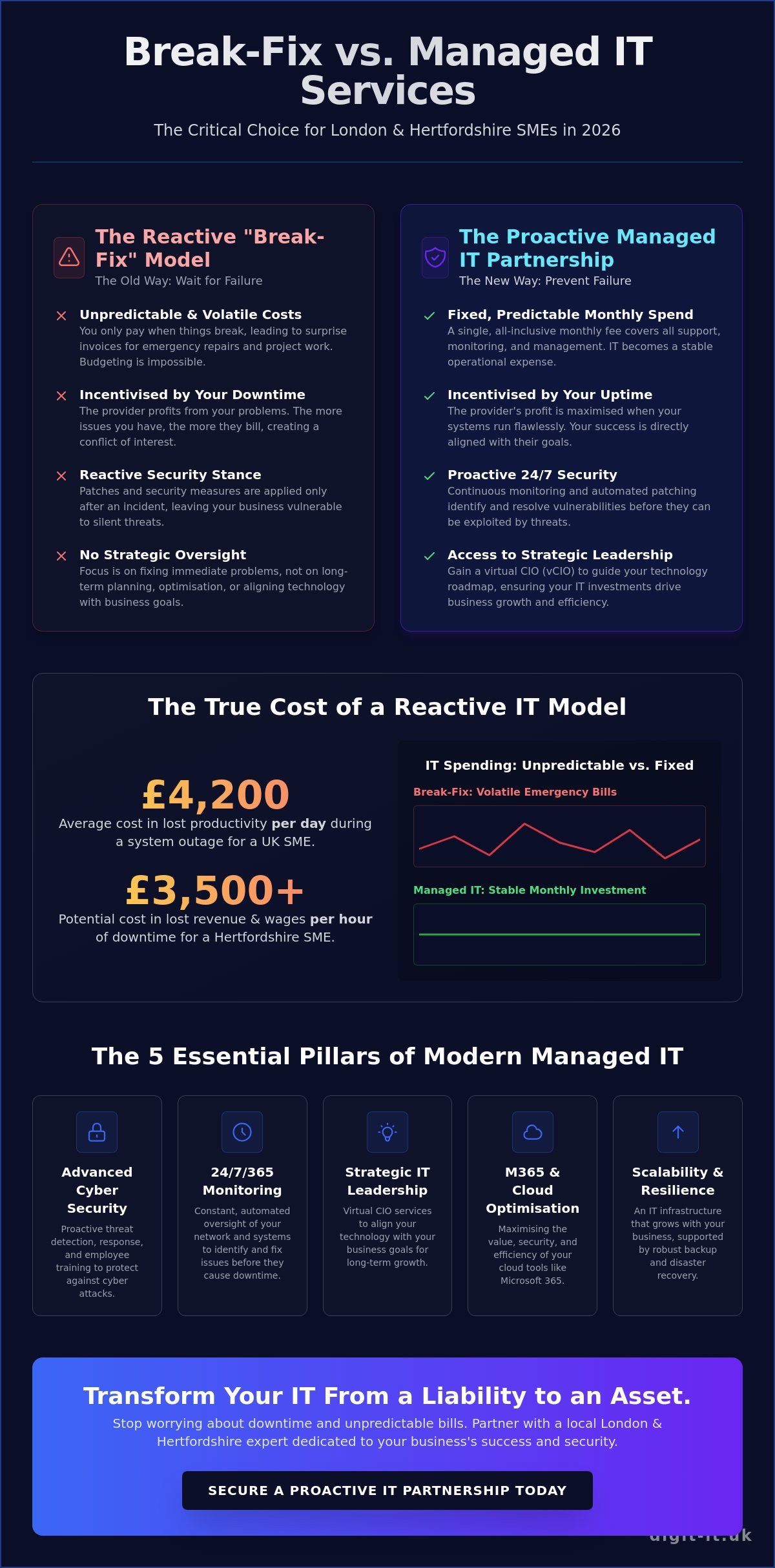
By 2026, the traditional “break-fix” model is a financial liability that costs the average UK small business £4,200 per day in lost productivity during a system outage. You likely feel the weight of unpredictable invoices and the constant anxiety that a single cyber attack could halt your operations across London or Hertfordshire. Implementing professional managed it services is no longer a luxury for the elite; it’s a fundamental requirement for any SME that views technology as a strategic accelerator rather than a recurring bottleneck.
This guide explains how to secure your business, eliminate downtime, and access high-level technical leadership without the mounting costs of an in-house department. We’ll show you how to transition to a predictable monthly spend while gaining the peace of mind that comes from a partner who truly understands local business challenges. We’ll explore the roadmap for proactive resilience and the specific digital tools required to future-proof your infrastructure over the next twelve months.
Key Takeaways
- Discover why the traditional “break-fix” approach is failing London SMEs and how a proactive model safeguards your reputation and productivity.
- Understand how managed it services provide high-level strategic leadership and robust security without the significant overhead of a full-time in-house department.
- Explore the five essential pillars of modern IT infrastructure, including advanced cyber security threat detection and the seamless optimisation of your Microsoft 365 tools.
- Learn the formula for comparing MSP costs against internal hiring to ensure your technology budget is transformed from an unpredictable expense into a fixed monthly investment in £ GBP.
- Identify the critical questions to ask potential providers and learn why a local presence in London and Hertfordshire is vital for responsive, on-site support and personal partnership.
What Are Managed IT Services? A Strategic Definition for 2026
Managed IT services represent a fundamental shift in how modern businesses handle their digital infrastructure. In the 2026 landscape, this model has evolved from simple technical support into a high-level strategic partnership. Rather than hiring an individual to fix a broken computer, a business enters into a proactive agreement where a third-party provider assumes total responsibility for the health, security, and performance of the entire IT environment. This approach is rooted in Wikipedia’s definition of Managed Services, which highlights the transition from reactive “break-fix” maintenance to a continuous, subscription-based management strategy.
For SMEs across London and Hertfordshire, this model removes the burden of day-to-day technical troubleshooting. It allows leadership teams to focus on growth while experts ensure the underlying technology remains resilient. The goal isn’t just to resolve issues but to prevent them from occurring in the first place, ensuring that your managed it services provider is as invested in your uptime as you are.
The Core Philosophy of the MSP Model
The traditional IT support model was inherently flawed because it incentivised failure. Under hourly billing, a provider only earned money when your systems were broken. The Managed Service Provider (MSP) model flips this logic entirely. By paying a fixed monthly fee, you align your provider’s goals with your own. Since the MSP’s profit margins decrease when they have to fix recurring issues, their primary objective becomes maintaining a flawless, “always-on” environment through 24/7 proactive monitoring.
- Predictable Budgeting: Fixed monthly costs replace the volatility of emergency repair bills.
- Proactive Resilience: Automated tools identify and patch vulnerabilities before they can be exploited.
- Scalable Support: The service grows with your business, adding capacity without the need for recruitment.
Managed IT Services are a dedicated IT department for a fraction of the cost.
Why Small Businesses in the Home Counties Need This Now
The business hubs of London and Hertfordshire face a unique set of digital pressures as we move through 2026. With 74 percent of UK firms now adopting permanent hybrid work models, the complexity of managing secure connections between office sites in Watford or St Albans and remote setups in Central London has skyrocketed. A local MSP provides the agility needed to manage these distributed networks with precision.
Relying on global call centres often leads to frustrating delays and a lack of contextual knowledge. In contrast, local expertise ensures a faster response and a deeper understanding of the regional business environment. Whether it’s navigating the specific connectivity challenges of the Home Counties or ensuring compliance with UK-specific data regulations, a local partner offers the “calm authority” required to keep a business competitive and secure.
Proactive Support vs. Break-Fix: Why the Old Way is Failing SMEs
For many SMEs across London and Hertfordshire, the traditional “break-fix” model feels like a budget-friendly choice. You only pay when something fails. However, by 2026, this reactive approach has become a significant liability. Gartner defines the managed network services market as a shift toward ongoing responsibility for maintaining a high-quality user experience. Waiting for a server to fail or a network to crash before calling for help creates a cycle of unpredictable costs and avoidable stress.
The old way of managing IT ignores the “silent” benefits of modern managed it services. While you might not see the background optimisations, automated patching, and firmware updates, they’re the engine room of a stable business. When these tasks are ignored, technical debt builds up. This debt eventually comes due in the form of system crashes or security breaches that could have been prevented with consistent oversight.
The High Price of “Cheap” IT Support
A single hour of downtime can cost a Hertfordshire SME upwards of £3,500 in lost revenue and wasted wages. This figure doesn’t include the long-term damage to your reputation when clients can’t reach your team. Relying on an ad-hoc technician means you’re often at the bottom of their priority list during a regional crisis. Without proactive management, backups often fail silently, leaving you vulnerable to total data loss. The “cheap” option quickly becomes the most expensive line item on your balance sheet when things go wrong.
The Proactive Advantage: Stopping Issues Before They Start
Switching to managed it services changes the dynamic entirely. Instead of fixing problems, we prevent them. Our 24/7 system monitoring and automated alert systems identify vulnerabilities before they escalate into outages. Regular security audits ensure your business stays compliant and resilient against emerging threats. Using managed IT support London provides a safety net that operates in the background, allowing your team to focus on growth rather than troubleshooting.
Modern business leaders view IT as a strategic asset. This transition from a cost-centre to an investment-in-growth mindset is what separates thriving SMEs from those struggling with legacy tech. It’s about building a foundation that scales with your ambitions. If you’re ready to move beyond reactive repairs and embrace a more stable future, you can explore our full range of strategic technology solutions to see how we protect your bottom line.
The 5 Essential Components of Managed IT Services
True managed it services function as a cohesive framework that protects your balance sheet while accelerating your operations. It’s not a buffet of options; it’s a unified strategy designed to eliminate technical friction. To achieve this, five pillars must work in harmony to support your business growth in 2026.
- Proactive Security: Moving beyond basic antivirus to 24/7 threat detection and response.
- Cloud Optimisation: Turning Microsoft 365 into a productivity powerhouse rather than just a storage bin.
- Resilience: Business continuity planning that ensures you can recover from a digital catastrophe in minutes, not days.
- Connectivity: Seamless VoIP and unified communications that bridge the gap between office and remote work.
- Strategic Guidance: Access to expert consultancy that aligns your technology roadmap with your commercial objectives.
Cyber Security and Data Resilience
The UK Government’s 2024 Cyber Security Breaches Survey found that 32% of businesses identified a breach or attack in the preceding 12 months. This makes Cyber Essentials certification a vital baseline for SMEs. It’s no longer just a “nice to have” badge; 66% of medium-sized UK firms now hold this certification to secure their supply chains. Managed firewalls act as your first line of defence, filtering out 99% of automated threats before they touch your network.
However, perimeter defence isn’t enough. You need cyber security for small business UK that prioritises immutable backups. These are write-protected data copies that ransomware cannot encrypt or delete. If a breach occurs, these backups allow for a clean, rapid restoration of your entire environment, ensuring your business remains operational regardless of the threat level.
Strategic Infrastructure and Cloud Management
Effective Microsoft 365 management involves more than licensing and email hosting. It’s about security hardening, SharePoint architecture, and automated workflows that save your team hours of manual data entry. Our approach to managed it services ensures your cloud environment is configured for maximum efficiency and minimum risk.
For teams dispersed across Buckinghamshire and London, VoIP systems provide the essential glue for collaboration. Modern unified communications reduce telephony costs by up to 30% while improving client response times through intelligent call routing. We ensure your physical hardware remains robust too. Proactive monitoring prevents the 42% of downtime typically caused by aging components, keeping your London office or Hertfordshire home-base running smoothly. By managing both the virtual and physical layers, we provide the “peace of mind” that allows you to focus on your core business goals.
Calculating the ROI of Managed IT for Your Business
Investing in technology shouldn’t feel like a gamble. For SMEs in London and Hertfordshire, the financial case for managed it services rests on shifting from volatile capital expenditure to predictable operational costs. Hiring a dedicated internal IT Manager in 2024 typically commands a salary between £45,000 and £55,000; this doesn’t include National Insurance, pension contributions, or the cost of ongoing training. A partnership with a managed provider delivers an entire team of specialists for a fraction of that total investment.
Predictable budgeting is the cornerstone of financial resilience. You eliminate the financial shock of a £2,000 server failure or a £5,000 emergency recovery fee. These surprise bills vanish, replaced by a fixed monthly subscription that simplifies your cash flow. This model allows you to allocate capital toward growth initiatives rather than emergency repairs. Productivity gains are equally measurable. If a 20-person team loses just 15 minutes a day to slow logins or software glitches, that totals 1,250 hours of lost labour annually. Proactive maintenance recovers this time, directly boosting your bottom line.
Direct vs. Indirect Cost Savings
Direct savings are often the easiest to track. We help you reduce hardware waste and lower software licensing costs by auditing your current subscriptions; many firms find they’re paying for “ghost” accounts that are no longer in use. Managed IT usually costs less than a single junior IT hire. Indirectly, the value is found in focus. Your senior team members shouldn’t spend three hours troubleshooting a VPN connection or a printer. When your staff stays focused on core business tasks, your operational efficiency improves significantly.
Future-Proofing Your Business Infrastructure
Strategic consultancy prevents the expensive mistake of purchasing redundant hardware that won’t support your goals in two years. We align your technology with a clear roadmap, ensuring your infrastructure scales seamlessly as you grow from 10 to 50 employees without a massive spike in overheads. Compliance is another critical ROI factor. With UK GDPR fines reaching up to £17.5 million or 4% of global turnover, the cost of a data breach far outweighs the investment in professional managed it services. We ensure your systems remain compliant with evolving UK regulations, protecting you from both legal and reputational damage.
Ready to stabilise your IT budget and drive growth? Explore our strategic managed IT services to see how we can optimise your business.
Choosing the Right Managed IT Partner in London & Hertfordshire
Selecting a partner to manage your technology is a pivot point for your business growth. It moves your operations from a reactive “break-fix” cycle into a state of strategic resilience. In the fast-paced corridors of London and the Home Counties, technology isn’t just a utility; it’s the engine of your competitive advantage. You need a partner that views your infrastructure through the lens of business outcomes rather than just technical tickets.
Before signing any contract, you must vet potential providers with rigorous questions. Ask about their specific experience with firms of your size and sector. Inquire about their security protocols: do they hold Cyber Essentials Plus certification? Demand clarity on their Service Level Agreements (SLAs) for both remote and on-site support. A true partner will provide transparent reporting and a clear roadmap for your digital evolution, ensuring you aren’t left behind as AI and automation redefine the market by 2026.
Local Expertise and Response Times
Physical proximity remains a critical asset for businesses in St Albans, Watford, or Central London. While many tasks are handled remotely, hardware failures and network outages often require boots on the ground. Having engineers who can reach your Hertfordshire office or London site within 60 to 90 minutes provides a level of security that remote-only firms cannot match. Local providers understand the regional business ecosystem, from the connectivity challenges in historic buildings to the high-demand requirements of the city’s financial districts. In 2026, 24/7 technical support is a baseline requirement to protect your global operations and hybrid teams.
The Digit-IT Partnership Model
Digit-IT brings over 20 years of technical excellence to the London and Buckinghamshire regions. We don’t just fix computers; we integrate with your team to function as your internal IT department. Our approach focuses on removing the friction from your daily operations, providing the “peace of mind” necessary for you to focus on your core objectives. We deliver high-level managed it services that are proactive, secure, and tailored to your specific growth targets.
We believe that technology is only as effective as the strategy behind it. Our “Trusted Advisor” status is earned through consistent performance and a commitment to future-proofing your infrastructure. We bridge the gap between human talent and digital tools, ensuring your team has the resilience to face any technical challenge. To see how we can optimise your business, Book your strategic IT consultation with Digit-IT today and secure your digital future.
Secure Your Competitive Edge in London and Hertfordshire
Transitioning from reactive break-fix models to proactive managed it services isn’t just a technical upgrade; it’s a strategic necessity for SMEs navigating the 2026 digital landscape. Recent UK government data indicates that the average cost of a cyber breach for small businesses has reached £4,224, making a robust defence more critical than ever. You now understand how integrating 24/7 monitoring and strategic infrastructure creates a resilient foundation for measurable ROI and long-term growth.
Digit-IT provides over 20 years of local expertise to help you master these complexities. We serve as your dedicated strategic partner across London and Hertfordshire, delivering proactive support that keeps your operations seamless and your team focused. We don’t just fix problems; we look over the horizon to ensure your technology remains a competitive advantage. It’s time to move past the anxiety of technical failure and embrace a model built for modern business continuity.
Secure your business and optimise your team with Digit-IT’s Managed IT Services
Your path to a more resilient, future-proofed business is ready when you are.
Frequently Asked Questions
What is included in a standard managed IT services package?
A standard managed IT services package provides a comprehensive ecosystem including 24/7 network monitoring, cybersecurity protocols, cloud infrastructure management, and unlimited helpdesk support. We focus on building digital resilience by including proactive patch management and regular strategic reviews. According to a 2024 CompTIA report, 60% of SMEs now include managed backup and disaster recovery as a core component of their service level agreements to ensure business continuity.
How much do managed IT services typically cost for a small business in the UK?
Managed IT services in the UK typically cost between £30 and £150 per user per month, depending on the complexity of your infrastructure. This investment allows SMEs to swap unpredictable capital expenditure for a fixed, monthly operational cost. A 2023 survey by the UK Government’s Department for Science, Innovation and Technology found that businesses spend an average of £4,960 annually on cybersecurity alone; a bundled service often proves more cost-effective.
Can managed IT services help my business stay compliant with GDPR?
Yes, managed IT services ensure your business remains compliant with UK GDPR by implementing robust data encryption, secure access controls, and automated audit trails. We align your digital infrastructure with the 7 key principles of the Data Protection Act 2018. By maintaining a secure environment, you reduce the risk of the Information Commissioner’s Office (ICO) issuing fines, which reached a total of £42 million in 2022 across various sectors.
What is the difference between an MSP and an IT consultant?
An MSP provides ongoing, proactive management of your entire digital environment, while an IT consultant typically focuses on specific, short-term strategic projects or advice. Think of an MSP as your long-term strategic partner that handles daily operations and future-proofing. Consultants usually exit once a project finishes, but 85% of SMEs prefer the MSP model because it ensures continuous business continuity and technical evolution.
Does my business need managed IT if we already have one “tech person” on the team?
Your business benefits from managed IT services by providing your internal “tech person” with the advanced tools and 24/7 backup they need to avoid burnout. One person can’t monitor threats every hour of the year or possess every specialized certification required in 2026. Partnering with an MSP gives your team access to a collective of experts, ensuring that 100% of your systems are monitored even when your internal staff is on holiday.
How quickly can a managed service provider respond to an emergency?
A professional MSP typically responds to critical “P1” emergencies within 15 to 60 minutes as defined in a Service Level Agreement (SLA). We use proactive monitoring tools to identify 90% of potential failures before they impact your operations. This rapid response is vital because the average cost of IT downtime for UK small businesses is estimated at £3,600 per hour by industry analysts.
Is my business too small for managed IT services?
No business is too small for managed IT services, as companies with as few as 5 employees are often the primary targets for automated cyberattacks. Small firms represent 43% of all data breaches according to recent UK cybersecurity reports. We scale our solutions to fit your specific headcount, providing the same high-level security and resilience used by larger enterprises but at a price point that respects your growth phase.
What happens if we want to cancel our managed IT service contract?
If you decide to cancel your contract, we initiate a structured offboarding process that ensures a seamless transfer of all credentials, documentation, and data to your new provider. Most UK service agreements require a notice period of 30 to 90 days to ensure a secure transition without service gaps. Our goal is to maintain professional integrity, ensuring your business remains protected and functional until the final handoff is complete.

