


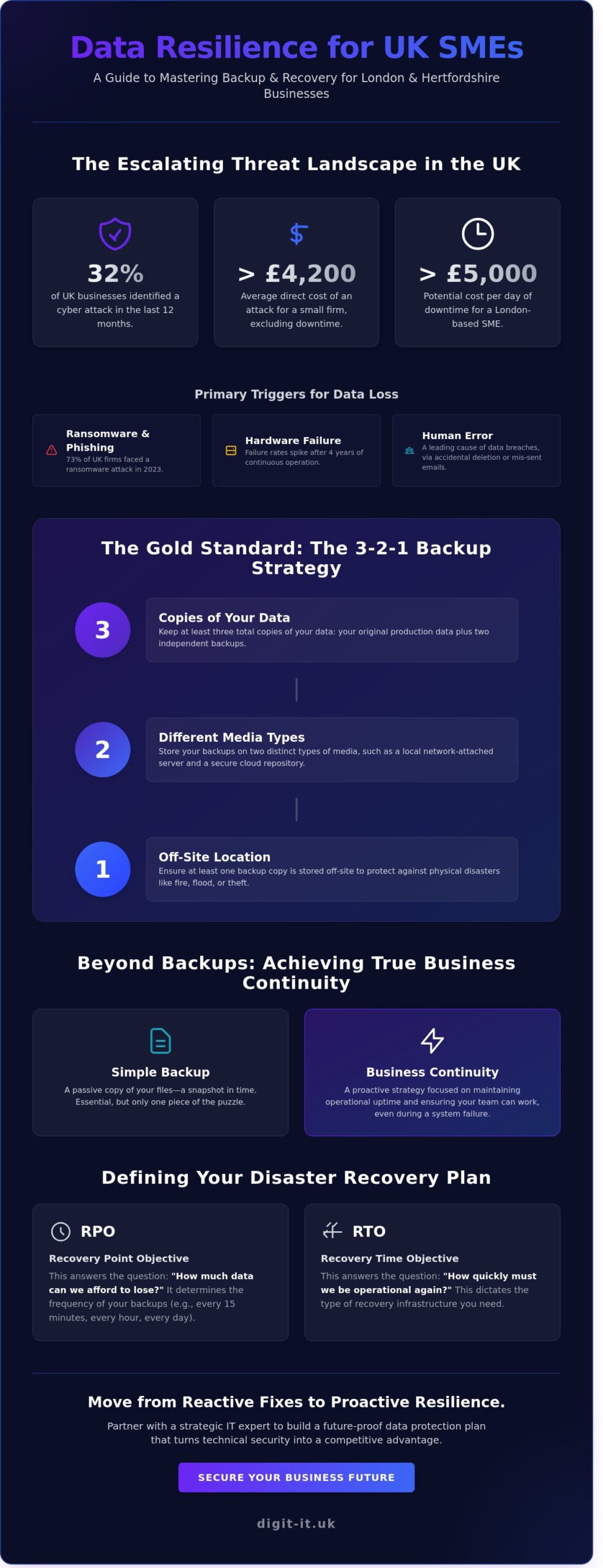
Did you know that 32% of UK businesses identified a cyber attack in the last 12 months? According to the 2024 UK Government Cyber Security Breaches Survey, these incidents often cost small firms over £4,200 in direct damages, yet the true price is the devastating downtime that follows. You likely recognize that your data is the lifeblood of your London or Hertfordshire firm, but the confusion between cloud storage and physical hardware often leads to strategic paralysis. It’s a common struggle for SMEs who need high-level security that respects a realistic budget.
We’re here to ensure your business stays resilient and ready for whatever 2026 brings. This guide helps you master data backup and recovery with a strategy designed specifically for the unique needs of UK small businesses. You’ll gain a clear, jargon-free understanding of how to meet compliance standards like Cyber Essentials while gaining the peace of mind that your operations can resume quickly after any failure. We will walk you through a proactive plan that bridges the gap between technical tools and your long-term commercial success.
Key Takeaways
- Learn the vital distinction between simple file syncing and robust business continuity to ensure your London or Hertfordshire firm remains resilient against evolving cyber threats.
- Implement the gold-standard 3-2-1 framework to create a redundant infrastructure that eliminates the risks associated with relying on a single cloud provider.
- Discover how a professional data backup and recovery strategy identifies your most business-critical assets and protects them from the “silent failure” of unmonitored systems.
- Master the essentials of Disaster Recovery planning by defining your RPO and RTO, ensuring your operations can resume seamlessly after any technical disruption.
- Explore how a proactive partnership model moves your SME beyond reactive “break-fix” support towards a future-proofed, managed digital environment.
Understanding Data Backup and Recovery for London and Hertfordshire Businesses
Securing your company’s digital assets isn’t just a technical box-ticking exercise; it’s a foundational requirement for survival in the competitive London and Hertfordshire markets. In a 2026 business context, data backup refers to the secure, automated duplication of your active files to a secondary, immutable location. Conversely, recovery is the strategic process of restoring that data to your live environment after a loss occurs. Effective data backup and recovery ensures that a hardware failure in a St Albans office or a sophisticated cyberattack in the City doesn’t lead to permanent closure.
Local businesses across the Home Counties are increasingly targeted by global cybercrime syndicates because they often possess high-value intellectual property but lack the enterprise-grade defenses of FTSE 100 firms. Statistics from the UK Cyber Security Breaches Survey 2024 show that 50% of UK businesses experienced a breach or attack in the preceding 12 months. For a London-based SME, the stakes are exceptionally high. A single day of downtime can cost upwards of £5,000 in lost productivity and missed opportunities, not to mention the long-term damage to client trust. Maintaining robust recovery protocols is also a non-negotiable requirement for UK GDPR compliance and achieving Cyber Essentials certification, which is now a standard prerequisite for many public sector contracts.
The Difference Between Backup and Business Continuity
Many business owners mistakenly believe that having a copy of their files on a cloud drive is sufficient. However, a backup is simply a snapshot in time. If your server fails, having the data is only half the battle; you also need the infrastructure to run it. Business continuity focuses on “uptime,” ensuring your team can keep working while the primary systems are being repaired. Business Continuity serves as a strategic shield that protects your operational integrity when primary systems fail. A well-structured business continuity plan ensures your SME has a clear, actionable roadmap for minimising downtime and maintaining operations through any crisis. By integrating comprehensive IT services, you move beyond simple storage toward total operational resilience.
Common Triggers for Data Loss in the UK
- Ransomware and Phishing: Sophisticated AI-driven phishing campaigns frequently target Greater London firms, with 73% of UK organizations facing at least one successful ransomware attack in 2023.
- Hardware Failure: Aging office infrastructure in older Hertfordshire business parks remains a significant risk. Hard drive failure rates typically spike after four years of continuous operation.
- Human Error: This remains the primary vulnerability for small teams. Data from the Information Commissioner’s Office (ICO) consistently identifies misdirected emails and accidental deletions as leading causes of data breaches in the UK.
Our role as a high-level strategic partner is to look over the horizon and identify these risks before they manifest. By aligning your data backup and recovery strategy with your broader growth goals, we turn technical resilience into a distinct competitive advantage in the London market.
The 3-2-1 Strategy: Building a Resilient Data Backup Framework
Resilience isn’t an accidental outcome; it’s a result of deliberate engineering. The 3-2-1 rule remains the industry benchmark for data backup and recovery because it systematically eliminates single points of failure. To achieve absolute redundancy, you must maintain three copies of your data. This includes your primary production data and two separate backups. These backups should exist on two different media types, such as a local physical server and a secure cloud repository. Crucially, one of these copies must be stored off-site.
Relying exclusively on a single cloud provider is a strategic oversight. While major platforms offer high availability, they aren’t immune to regional outages or account-level compromises. Diversifying your storage locations ensures that a service disruption at one provider doesn’t bring your entire business to a standstill. We focus on creating a seamless flow where data is moved automatically. Manual processes are prone to human error, which accounted for 68% of data loss incidents in 2024. By implementing automated, “set and forget” schedules, we ensure your protection layers update every hour without requiring a second thought from your team.
On-Premise vs. Cloud Backup: Finding the Balance
For Hertfordshire offices, local Network Attached Storage (NAS) units offer the advantage of high-speed recovery. If you need to restore a 500GB database, pulling that data over a local network is significantly faster than downloading it over a standard UK broadband connection. However, local hardware is vulnerable to physical theft, fire, or flood. The cloud provides the scalability growing teams need, allowing you to expand your storage capacity instantly as your data footprint grows. A hybrid model is often the most prudent choice for SMEs. It delivers the immediate access of local hardware alongside the geographic redundancy of the cloud.
Immutable Backups and Ransomware Protection
By 2026, standard backups are no longer a guaranteed safety net. Modern ransomware variants are designed to seek out and encrypt backup files before locking the primary system. Immutable backups are the gold standard for defending against these attacks. Once data is written in an immutable format, it cannot be changed, overwritten, or deleted for a specific duration. Even an attacker with administrative privileges cannot bypass this lock.
Pairing immutability with air-gapped storage creates a logical gap that prevents malware from jumping between systems. This proactive approach is a vital component of Cyber Security for Small Business UK, providing a final line of defence that remains untouchable during a breach. If you want to ensure your infrastructure is future-proofed against these evolving risks, our bespoke managed services can help you implement a hardened recovery framework.
Why Traditional Backups Often Fail Small Businesses in the UK
Many UK business owners believe they’re protected when they aren’t. A 2023 report by Beaming revealed that UK businesses lose roughly £3.7 billion annually to downtime and data loss. Most of these losses happen because of a fundamental misunderstanding of data backup and recovery protocols. Relying on legacy systems or consumer-grade tools creates a fragile environment that crumbles under the pressure of a real cyber incident or hardware failure. True resilience requires more than just a copy of your files; it requires a verified path to restoration.
The “Sync vs. Backup” Trap
Tools like OneDrive, Google Drive, or Dropbox are excellent for collaboration, but they don’t constitute a true backup. When a user accidentally deletes a folder or a ransomware strain encrypts your local files, those changes propagate across all synced devices in seconds. While version history offers a limited safety net, it’s often restricted to 30 days and doesn’t protect your entire system architecture or configuration. Sync is for productivity, backup is for survival. A dedicated backup archive ensures you have an immutable copy of your data that remains untouched by local errors or malicious syncs. Without this separation, a single mistake in the London office can wipe out your entire digital footprint across the globe instantly.
The Importance of Regular Integrity Testing
A “success” notification is often the most dangerous lie in IT. Backups fail for numerous reasons: bit rot, local hardware faults, or software conflicts that corrupt the data during the transfer. Without weekly verification, you’re essentially gambling with your business continuity. Restoration often fails at the worst possible moment because the metadata is broken or the encryption keys are inaccessible. Research indicates that 20% of small business restores fail due to media corruption or incomplete data sets. By leveraging managed services, you gain the oversight needed to ensure every byte is recoverable. We move beyond the “green tick” by performing sandboxed recovery tests, proving that your data isn’t just stored, but functional.
For a high-paced London SME, time is the most expensive commodity. The average cost of downtime for a small UK firm is estimated at £5,000 per day. If your recovery process takes 48 hours because you’re pulling data over a saturated 100Mbps line, you’ve already lost £10,000 before you’ve even sent your first email. A robust data backup and recovery strategy prioritises local recovery speed alongside cloud resilience to keep these costs from spiralling. We focus on these critical factors to ensure your business stays operational:
- Recovery Time Objectives (RTO): Defining exactly how many hours your business can afford to be offline.
- Recovery Point Objectives (RPO): Determining how much data you can afford to lose between backup intervals.
- Off-site Redundancy: Ensuring a copy of your data exists outside of your primary physical location to protect against fire or theft.
- Automated Monitoring: Replacing manual checks with proactive alerts that flag issues before they become disasters.
Beyond the Copy: Creating a Practical Disaster Recovery Plan
Backups are your insurance, but a Disaster Recovery (DR) plan is your emergency response. While a backup ensures your files exist somewhere, a DR plan defines how you get back to work. To build true resilience, you must understand two metrics: RPO and RTO. Recovery Point Objective (RPO) refers to your data loss tolerance. If your last backup was at midnight and your system crashes at 10:00 AM, you’ve lost ten hours of work. For a financial firm in the City, that’s often unacceptable. Recovery Time Objective (RTO) is the duration of downtime. It’s the clock ticking while your team sits idle and revenue evaporates.
Calculating Your RTO: How Long Can You Stay Offline?
For a London-based firm, the cost of being offline is staggering. Industry data from 2023 suggests that downtime costs UK SMEs an average of £4,220 per hour in lost productivity and missed opportunities. Setting realistic targets depends on your sector. A retail business might need an RTO of minutes to process transactions, while a creative agency might tolerate a few hours. Partnering with Managed IT Support London accelerates this process. Proactive monitoring and virtualised environments allow us to spin up your servers in the cloud, ensuring your data backup and recovery strategy isn’t just a static file, but an active safety net.
Identifying your business-critical data assets is the next step. Not all data is equal. You should categorise your assets into three tiers: mission-critical (CRM and financial software), operational (email and project management), and archival. Assigning specific roles during an emergency prevents chaos. You need a designated Recovery Lead to manage the technical restoration and a Communications Lead to handle client expectations. This structured approach ensures that when a crisis hits, everyone knows their position on the pitch.
The Disaster Recovery Checklist for SMEs
Resilience requires a clear paper trail. This isn’t just for your team; it’s a requirement for GDPR compliance and most cyber insurance policies. If you can’t prove you had a tested recovery plan, insurers may contest your claim. Your checklist should include:
- Asset Inventory: Document all hardware, software licences, and cloud credentials in a secure, offline location.
- Communication Strategy: Establish how you’ll reach staff and clients if your primary email server is down.
- Stakeholder Map: Maintain an updated list of vendors, ISP contacts, and emergency IT support numbers.
- Post-Recovery Analysis: Within 48 hours of an event, review what failed and update your data backup and recovery procedures to prevent a recurrence.
Your business deserves a strategy that looks beyond the next 24 hours. We help you build a future-proofed infrastructure that stays standing when others falter. We bridge the gap between human talent and digital tools to keep your operations seamless. For a comprehensive framework covering every aspect of operational resilience, our business continuity plan checklist for Hertfordshire and London SMEs provides the strategic roadmap your firm needs to stay functional through any disruption in 2026.
Proactive Data Protection: How Digit-IT Secures Your Business Future
Relying on a reactive “break-fix” model is a gamble that modern SMEs can’t afford. When systems fail, the cost isn’t just the repair bill; it’s the average £4,267 daily productivity loss that UK businesses face during downtime. Digit-IT shifts the focus from recovery to resilience. We don’t wait for your servers to fail or a ransomware prompt to appear. Our proactive monitoring identifies vulnerabilities before they escalate into crises, ensuring your data backup and recovery strategy is always operational and tested.
We design bespoke backup solutions specifically for SMEs across Hertfordshire and Buckinghamshire. These aren’t off-the-shelf products. We integrate these protections into our broader IT services, creating a unified digital environment where security is built-in, not bolted on. If a disaster does strike, our 24/7 UK-based helpdesk provides immediate, expert support. You won’t be navigating a complex automated phone menu; you’ll speak with an engineer who knows your infrastructure and is committed to restoring your operations within minutes.
Seamless Integration with Microsoft 365
Many business owners assume their data is safe because it’s in the cloud. However, Microsoft’s Shared Responsibility Model explicitly states that data protection remains the user’s responsibility. We provide the essential third-party backup layer that native tools lack. By overseeing your Microsoft 365 Management, we protect every email, Teams chat, and SharePoint file from accidental deletion or malicious attacks. Our approach simplifies your overheads by consolidating management and billing into a single, predictable monthly cost.
Your Trusted IT Partner in the Home Counties
Local expertise matters when time is of the essence. Our engineers live and work in the same geographic areas as our clients, meaning we understand the local infrastructure and the specific challenges faced by businesses in the Home Counties. We act as your Virtual CTO, providing the strategic foresight needed to future-proof your digital assets as you scale. We don’t just fix computers; we partner with you to ensure technology drives your growth rather than hindering it. A complete data protection strategy also extends to hardware disposal — understanding how to wipe a laptop securely before recycling or reselling devices is an essential step in preventing sensitive business data from falling into the wrong hands.
Don’t wait for a data breach to test your defences. Secure your business future today. Contact Digit-IT for a free IT health check and gain the peace of mind that comes with professional data backup and recovery.
Secure Your Business Legacy in 2026 and Beyond
Waiting for a system failure to test your resilience is a risk your Hertfordshire firm can’t afford. This guide demonstrates that robust data backup and recovery requires more than just a simple copy; it needs a disciplined 3-2-1 framework and a practical disaster recovery plan. Many traditional backups fail UK small businesses because they lack the proactive testing required to survive modern cyber threats. You need a strategy that protects your continuity while you focus on growth.
Digit-IT serves as your dedicated strategic partner, offering 20+ years of experience supporting London SMEs. Our Cyber Essentials certified experts provide 24/7 proactive monitoring and a UK-based helpdesk to keep your infrastructure resilient. We bridge the gap between complex digital tools and your business goals, ensuring your technology is an asset rather than a liability. It’s time to move toward a secure, future-proof operation with a partner who understands the local landscape.
Book Your Free Data Security Audit with Digit-IT Today
Your peace of mind is our priority, and we’re ready to secure your digital future today.
Frequently Asked Questions
What is the difference between data backup and data recovery?
Backup is the proactive process of creating a secure copy of your digital assets, while recovery is the strategic restoration of that data to your systems after a loss. Think of it as the difference between owning a spare key and the actual act of unlocking your door when you’re locked out. Effective data backup and recovery ensures that your business stays resilient by minimizing downtime during unexpected technical failures or cyberattacks.
Is a cloud-only backup sufficient for my small business in London?
Relying solely on the cloud isn’t recommended for London businesses that prioritize rapid restoration and operational continuity. While cloud storage offers excellent off-site protection, local hardware backups provide significantly faster recovery speeds for large datasets. A hybrid approach ensures your business remains functional even if your internet connection fails, which affected 15% of UK businesses in 2023 according to industry reports. We recommend combining both for total coverage.
How often should my business perform data backups?
You should perform backups at least once every 24 hours, though many modern firms now opt for continuous data protection to capture changes in real-time. The frequency depends on your Recovery Point Objective (RPO). If your team produces 50 new files per hour, a daily backup risks losing a full day of productivity. We suggest hourly increments for high-traffic environments to ensure your business continuity remains intact and your data stays current.
Does UK GDPR require me to have a data backup plan?
UK GDPR Article 32 explicitly requires businesses to have the ability to restore availability and access to personal data in a timely manner following a physical or technical incident. Failing to maintain a tested data backup and recovery strategy can lead to significant fines from the Information Commissioner’s Office (ICO). In 2022, the ICO issued several penalties specifically citing poor technical measures for data resilience as a primary compliance failure.
What happens if my backup is also infected by ransomware?
If your backup is connected to your primary network during an attack, the ransomware will likely encrypt it as well, making your recovery efforts impossible. This is why we implement “immutable” backups that cannot be altered or deleted once written. Statistics from Sophos in 2023 show that 75% of ransomware attacks also targeted backup repositories. Using air-gapped or immutable storage is the only way to ensure your files remain safe and recoverable.
How long does it usually take to recover data after a system failure?
Recovery time varies from 15 minutes to several days depending on your Recovery Time Objective (RTO) and the volume of data involved. Restoring a single file from a local drive is nearly instantaneous, but rebuilding an entire server from a cloud source takes longer. A professional disaster recovery plan defines these timelines upfront so your business knows exactly when it will be back online. We help you optimise these targets to prevent financial loss.
Can I manage my own business backups or do I need a professional?
You can manage your own backups using off-the-shelf software, but 60% of small business owners fail to test if those backups actually work. Professional management provides proactive monitoring and regular integrity checks that internal teams often overlook. We act as your strategic partner, ensuring your digital infrastructure is future-proofed against human error and hardware failure. This allows you to focus on growth while we handle the technical complexities of your security.
What is the “3-2-1” backup rule and why is it recommended?
The 3-2-1 rule dictates that you keep 3 copies of your data, stored on 2 different types of media, with 1 copy kept off-site. This framework is the global gold standard for resilience because it eliminates single points of failure. If your London office suffers a fire or theft, having that one off-site copy ensures your business doesn’t lose its most valuable digital assets permanently. It’s a simple yet powerful method for protecting your long-term success. When decommissioning old hardware as part of your data lifecycle management, ensure you also follow best practices for how to wipe a laptop securely to prevent sensitive information from being recovered from disposed devices.

