
What if the reactive ‘break-fix’ model you currently rely on is actually the single biggest threat to your London firm’s 2026 growth targets? You likely already feel the sting of frequent downtime, knowing that every minute your Hertfordshire team spends staring at a loading icon is a minute stolen from your bottom line. It’s a common frustration, especially when the UK Government’s 2024 Cyber Security Breaches Survey reveals that 50% of UK businesses identified a breach or attack in the last 12 months. This guide shares the essential tips for Digit-IT success to help you move beyond firefighting and into a position of calm, strategic control.
You’ll discover how to align your digital strategy with proactive IT support to ensure growth, security, and resilience across Greater London and the Home Counties. We’re going to outline the roadmap for turning your IT infrastructure into a seamless extension of your team. This ensures you benefit from predictable costs and the robust data security required to thrive in an increasingly complex digital environment.
Key Takeaways
- Discover how to transform your technology from a reactive cost into a strategic asset by aligning your digital roadmap with long-term business objectives in London and Hertfordshire.
- Understand the financial and operational benefits of moving beyond the “break-fix” mentality toward a proactive managed support model that prevents downtime before it occurs.
- Learn why a robust cybersecurity posture is essential for business continuity and how to protect your SME against the increasingly sophisticated threat landscape of 2026.
- Implement practical Tips for Digit-IT success by utilising unified communications and cloud-based tools to streamline productivity across your hybrid South East workforce.
- Identify the critical criteria for selecting a trusted IT partner in Buckinghamshire to help you scale efficiently through bespoke, future-proofed technology solutions.
Navigating Digital IT Success in Greater London and the Home Counties
Digit-IT success represents the point where your technology stops being a cost centre and starts being a growth engine. It’s the seamless integration of bespoke digital tools with your overarching commercial strategy. By 2026, the digital landscape for SMEs across London and Hertfordshire has shifted significantly. The UK government’s 2024 Digital Strategy paved the way for widespread Digital Transformation, making high-speed connectivity and cloud-native operations the baseline for survival. If you are searching for practical Tips for Digit-IT success, you must first acknowledge that technology is only as good as the strategy behind it.
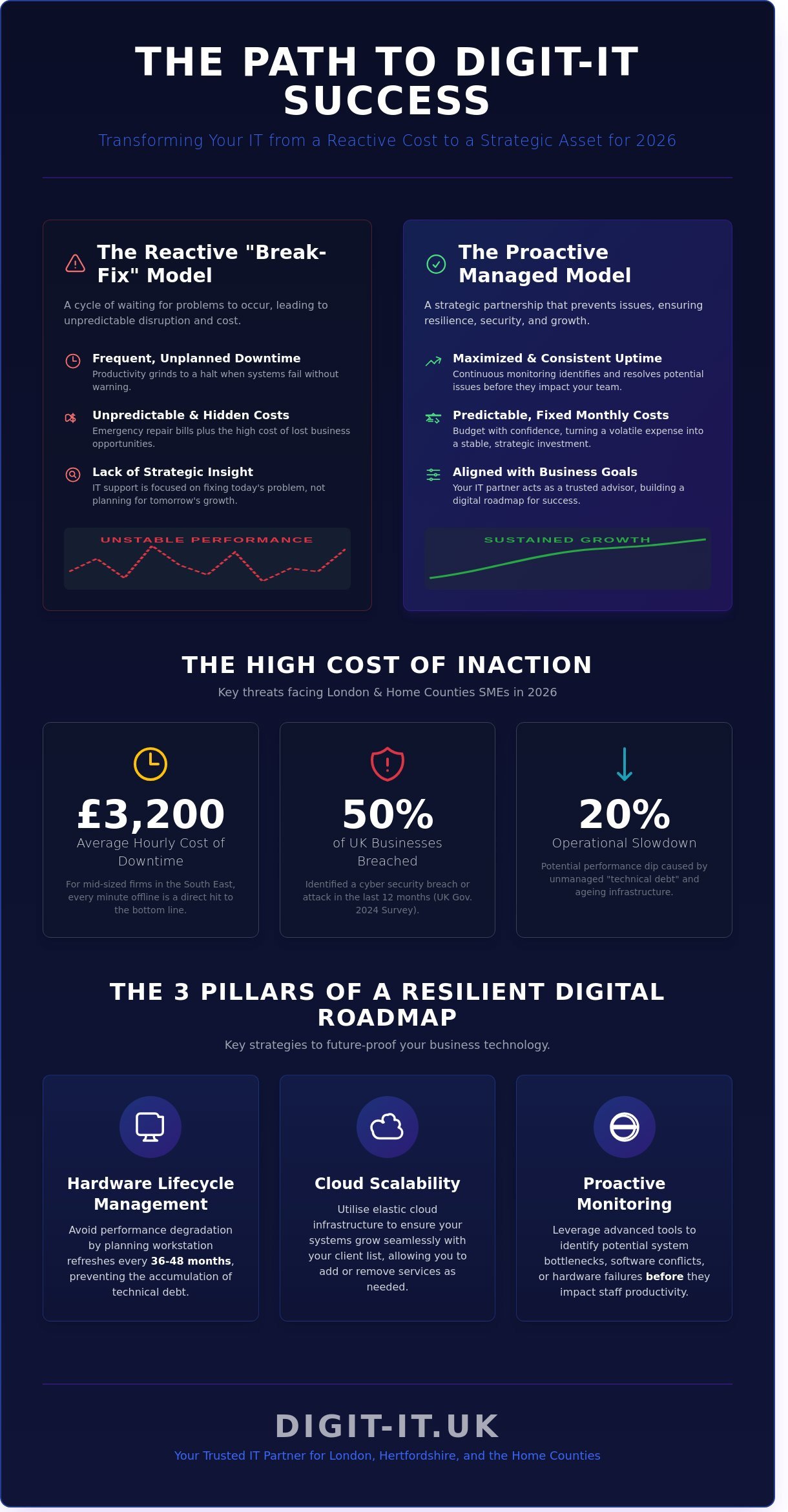
Waiting for hardware to fail before seeking help is no longer a viable strategy for competitive firms. Traditional IT support often focuses on the “break-fix” cycle, which leads to unpredictable downtime and hidden costs. In 2026, downtime costs for mid-sized firms in the South East average over £3,200 per hour. Leading organisations now adopt the “Trusted Advisor” model. This approach ensures your IT partner acts as an extension of your internal team, focusing on long-term health rather than short-term patches. This shift provides the peace of mind needed to focus on your core business objectives.
Why Local Context Matters for Your IT Strategy
London’s business districts often grapple with legacy infrastructure hidden behind Victorian facades, while the burgeoning tech hubs in Watford, St Albans, and Stevenage benefit from more modern fibre rollouts. Proximity to your IT partner remains a critical factor for success. While remote support handles 92% of daily tickets, having a local expert who understands the regional nuances of the M25 corridor ensures faster on-site response when physical hardware issues arise. Implementing these Tips for Digit-IT success will help your Hertfordshire firm remain agile as market conditions shift.
The Core Pillars of a Successful Digital Roadmap
A robust digital roadmap requires synchronising hardware refresh cycles with your projected headcount growth. This prevents the accumulation of technical debt, which can slow down operations by as much as 20% if left unmanaged for more than three years. Scalability is your primary defence against obsolescence, allowing you to add or remove managed services as your workload fluctuates. To protect your investment, you must build a culture of security from the ground up.
- Hardware Lifecycle Management: Avoid the performance dip associated with ageing workstations by planning refreshes every 36 to 48 months.
- Cloud Scalability: Use elastic infrastructure to ensure your systems grow at the same pace as your client list.
- Proactive Monitoring: Identify potential bottlenecks before they impact your staff’s productivity.
Digital resilience is the ability to maintain operations during technical or security disruptions.
Prioritising Proactive Managed Support Over Reactive Repairs
Relying on a “break-fix” model is a gamble that few London SMEs can afford to take as we head into 2026. When technology fails, the immediate repair bill is often the smallest part of the problem. You also have to account for the total halt in staff productivity, potential reputational damage, and the missed opportunities that occur while your systems are offline. One of the most vital tips for Digit-IT success is recognising that reactive repairs are fundamentally regressive. They keep your business in a state of constant recovery rather than growth.
Proactive monitoring changes this dynamic by identifying system vulnerabilities, such as a failing hard drive or a pending software conflict, before they escalate into a full-scale outage. This approach ensures your digital infrastructure remains resilient. By following established Cyber Guidance for Small Businesses, you can implement layers of protection that stop threats at the perimeter. This technical foresight provides a level of calm authority for business owners. You no longer have to worry about arriving at the office on Monday morning to find your systems crippled by a preventable error.
Transitioning to a managed model turns IT from a source of anxiety into a predictable monthly investment. It removes the volatility of emergency invoices and replaces it with a steady, manageable cost structure that supports long-term strategic planning.
What to Expect from a Managed IT Partnership
A true partnership goes beyond basic maintenance. You gain access to 24/7 system monitoring and a dedicated helpdesk that acts as a safety net for your entire team. This ensures that minor glitches are resolved instantly, keeping your workflow seamless. We provide regular IT health checks and performance audits to keep your hardware running at peak efficiency. By integrating Managed IT Support into your operations, you effectively gain an entire department of experts who function as a natural extension of your internal team, focused entirely on your business continuity.
Budgeting for IT Success in 2026
Financial agility is a cornerstone of modern business. Shifting your IT costs from capital expenditure (CapEx) to operational expenditure (OpEx) allows you to preserve cash flow for other growth initiatives. Per-user or per-device pricing models mean your costs only scale when your team does, ensuring you never pay for capacity you don’t use. This structure helps you avoid the “emergency call-out” trap, where a single server failure can result in an unplanned £2,000 repair bill. Instead, you enjoy a fixed, transparent fee that covers everything you need to stay competitive. If you want to see how this model can stabilise your overheads, you might consider how our team can optimise your current setup for better efficiency.
Strengthening Your Cyber Security Posture for 2026
The digital landscape for small businesses in London and Hertfordshire is shifting rapidly. According to the UK Government’s Cyber Security Breaches Survey 2024, 50% of all UK businesses identified a breach or attack in the previous 12 months. As we approach 2026, these threats are becoming more sophisticated, often leveraging automated AI tools to find vulnerabilities. Security is no longer a niche technical concern; it is a fundamental business continuity issue. If your systems are compromised, your ability to trade vanishes instantly. This makes proactive protection one of the most vital tips for Digit-IT success in the coming years.
Many local business owners still operate under the dangerous assumption that they are too small to be a target. This logic is flawed. Cybercriminals rarely target specific names; they use scripts to scan thousands of IP addresses for weak points. For these attackers, a small business with basic security is a much easier, more profitable target than a large corporation with a dedicated security operations centre. Protecting your firm requires a shift in mindset where security is viewed as an investment in resilience rather than a mere cost centre.
Technology alone cannot secure your perimeter. Employee behaviour remains the most significant variable in your defence strategy. Research indicates that approximately 90% of successful data breaches involve some form of human error, such as clicking a phishing link or using weak passwords. Establishing a culture of digital hygiene is essential. Following the UK government’s cybersecurity advice ensures your team understands the basics of device security and reporting suspicious activity before it escalates into a crisis.
Achieving the Cyber Essentials Standard
Cyber Essentials is the UK’s gold standard for SME credibility. It provides a clear framework that focuses on five technical controls: firewalls, secure configuration, user access control, malware protection, and patch management. Implementing these controls can mitigate up to 80% of common cyber threats. For businesses in the capital, undergoing regular Cyber Security audits demonstrates to your clients that you take their data privacy seriously, protecting your reputation in a competitive market.
Implementing a Robust Data Backup and Recovery Plan
Data is the lifeblood of your 2026 operations. A “set and forget” approach to backups often leads to failure during a real crisis. We advocate for the 3-2-1 rule: maintain three copies of your data, on two different media types, with one copy stored securely off-site. Testing your disaster recovery plan every 90 days is a non-negotiable requirement for success. Utilising a professional Data Backup & Recovery service ensures that if a ransomware attack or hardware failure occurs, your business can be fully operational again within hours, avoiding the devastating costs of prolonged downtime.
Optimising Business Communications with VoIP and Microsoft 365
The UK is approaching a critical infrastructure milestone. By December 2025, BT will decommission the Public Switched Telephone Network (PSTN), rendering traditional landlines obsolete. For firms in London and Hertfordshire, migrating to Voice over Internet Protocol (VoIP) isn’t just a technical upgrade; it’s a necessity for survival in 2026. This transition allows your team to communicate from any location while maintaining a unified corporate identity. Modern unified communications ensure that a staff member working from a home office in St Albans has the same tools as a colleague in a Shoreditch studio.
One of the primary Tips for Digit-IT success involves consolidating your disparate tools into a single, managed ecosystem. This approach eliminates the “app fatigue” that plagues 43% of UK employees who report switching between different communication platforms at least ten times an hour. By integrating your telephony with your productivity suite, you reduce monthly overheads and simplify your billing process. A scalable cloud system grows alongside your business, allowing you to add users or features with a few clicks rather than waiting for an engineer to visit your premises.
Maximising Your Microsoft 365 Investment
Most businesses only scratch the surface of their subscription. True efficiency comes from moving beyond basic email into deep collaboration via SharePoint and OneDrive. These tools provide a “single source of truth” for documents, preventing the version-control issues that waste hours of billable time. To protect your data on the move, we use Microsoft Intune to secure mobile devices; this ensures company information stays safe even if a laptop is lost on the Thameslink. You can explore our Expert Microsoft 365 Management to see how we tailor these tools for local firms.
The Strategic Advantage of VoIP for London Businesses
A London-based 020 number carries significant prestige. VoIP allows you to keep that professional presence regardless of where your team is physically located. It integrates your voice services directly into your digital workflow, meaning calls can be logged automatically in your CRM. This level of connectivity boosts productivity by approximately 20% according to industry benchmarks. By removing the cost of physical line rentals, you free up capital to reinvest in your core growth strategies. Implementing these Tips for Digit-IT success ensures your communication remains resilient against future disruptions.
Scaling Your Business with a Trusted IT Partner in Buckinghamshire
Growth in Buckinghamshire’s SME sector, which saw a 4.2% increase in new business registrations according to 2023 regional data, demands a robust technical foundation. You can’t scale a modern enterprise on legacy systems that struggle to communicate. Finding the right IT consultancy requires looking beyond basic technical support. You need a partner who understands the specific compliance hurdles of your industry, whether that’s financial services in Milton Keynes or manufacturing in High Wycombe. Seek out firms with UK-recognised credentials like Cyber Essentials Plus to ensure your data remains resilient as you expand.
A technology roadmap is the most critical tool for long-term stability. Without one, businesses often fall into the trap of “technical debt,” where rushed solutions create costly integration problems later. Implementing these Tips for Digit-IT success ensures your infrastructure scales alongside your revenue. A strategic partner moves you away from the “break-fix” cycle. Instead of reacting to failures, you’ll benefit from proactive monitoring and a five-year plan that aligns your digital spend with your commercial objectives. This transition turns IT from an overhead into a genuine competitive advantage.
The Digit-IT Approach: Human-Centric Technology
Technology is only as effective as the people who use it. With over 20 years of experience in the UK market, we’ve seen that the most successful digital transformations focus on the user experience. We bridge the gap between complex digital tools and your human talent, ensuring your team feels empowered rather than overwhelmed. Our partnership model prioritises your business growth over simple hardware sales. We focus on creating a seamless environment where your staff can work efficiently from any location, whether they’re in a London office or a home studio in Hertfordshire.
Next Steps: Your Digital Success Audit
Taking control of your digital future starts with a clear understanding of your current position. To prepare for an initial consultancy session, gather your current software licences and a list of your most frequent technical “pain points.” We often identify “quick wins” during these sessions, such as optimising cloud subscriptions to reduce monthly outgoings or enabling Multi-Factor Authentication (MFA) to immediately harden your security posture. These small changes provide the momentum needed for larger strategic shifts. Following these Tips for Digit-IT success will help you build a resilient, future-proofed organisation.
Don’t let technical uncertainty hold your business back from its full potential in 2026. Book your free IT health check with Digit-IT today and take the first step towards a secure, high-performance digital future.
Secure Your Competitive Edge for 2026 and Beyond
Building a resilient business in London or Hertfordshire requires a shift from reactive repairs to a strategic, proactive mindset. These Tips for Digit-IT success demonstrate that securing your infrastructure for 2026 involves more than just standard software updates. It demands a comprehensive approach to cyber security and scalable communications that can adapt to rapid market changes. By leveraging Microsoft 365 and high-performance VoIP, your organisation can maintain seamless connectivity across the Home Counties without the burden of technical debt.
Digit-IT provides 24/7 proactive monitoring and over 20 years of technical expertise to ensure your SME remains operational, secure, and agile. We don’t just fix problems; we prevent them from occurring in the first place. This partnership ensures your digital tools are always aligned with your long-term commercial goals, providing the peace of mind needed to focus on expansion. It’s time to move beyond traditional IT support and embrace a model that prioritises your business continuity.
Secure your business future with a bespoke IT strategy from Digit-IT. Your journey towards a more secure, optimised, and future-proof enterprise starts today.
Frequently Asked Questions
What are the first steps for a small business starting a digital transformation?
Start by conducting a comprehensive audit of your current workflows to identify where manual tasks slow down growth. According to a 2024 McKinsey report, 70% of digital transformations fail due to lack of employee engagement, so prioritise staff training alongside your tech rollout. These initial tips for Digit-IT success involve migrating legacy data to secure cloud environments like Microsoft 365 to ensure immediate scalability and better collaboration.
How much should a London SME typically budget for IT support in 2026?
A London SME should allocate between £60 and £150 per user per month for comprehensive managed IT support in 2026. This range accounts for the rising costs of advanced cybersecurity tools and the 4.1% average annual inflation seen in UK service sectors. Investing at this level ensures you receive proactive monitoring and a dedicated account manager rather than just reactive, basic assistance when things go wrong.
Is managed IT support better than having an in-house IT person?
Managed IT support is generally more cost-effective and resilient than a single in-house hire for most SMEs. A mid-level IT Manager in London commands an average salary of £55,000 plus benefits, whereas a managed service provider gives you access to a whole team of specialists for a fixed monthly fee. This partnership model provides 24/7 coverage and eliminates the risk of a single point of failure when an employee is on holiday.
What is the most common cyber security threat for UK businesses today?
Phishing remains the most prevalent threat, with the UK Government’s Cyber Security Breaches Survey 2024 reporting that 84% of businesses identified this as their primary attack vector. These attacks have become more sophisticated through AI-generated content that mimics professional correspondence perfectly. We recommend implementing multi-factor authentication (MFA) across all accounts to block 99.9% of automated password-based attacks and keep your perimeter secure.
Can VoIP systems work reliably with poor internet connections in rural Hertfordshire?
VoIP systems can work reliably in rural Hertfordshire if you implement a structured connectivity strategy. While standard ADSL might struggle, 2024 data from Ofcom shows that 4G and 5G coverage now reaches over 90% of the county, providing a viable failover for voice traffic. We often deploy SD-WAN technology to prioritise voice packets, ensuring crystal-clear calls even when your primary broadband bandwidth fluctuates during peak hours.
What happens if our data is lost and we don’t have a recovery plan?
Losing data without a recovery plan can lead to permanent business closure, as 60% of small firms shut down within six months of a major data loss according to industry statistics. You’ll face immediate operational paralysis and potential fines from the ICO under UK GDPR regulations if client data is compromised. Establishing a robust backup routine is one of the most vital tips for Digit-IT success to ensure long-term business continuity.
How often should our business hardware be upgraded for optimal performance?
You should plan to refresh your business hardware every three to four years to maintain peak productivity. After 48 months, the failure rate for standard laptops increases by 25%, leading to hidden costs in lost employee time and expensive emergency repair fees. Regular upgrades ensure your team can run the latest resource-heavy applications without the lag that typically affects older processors and limited memory.
Is Microsoft 365 secure enough for businesses handling sensitive client data?
Microsoft 365 is highly secure for sensitive data, provided you utilise the advanced security features found in Business Premium or Enterprise licenses. These tiers include Microsoft Purview for data loss prevention and Intune for mobile device management. When configured correctly by a strategic partner, these tools ensure your client information remains encrypted and accessible only to authorised personnel on approved devices.
