
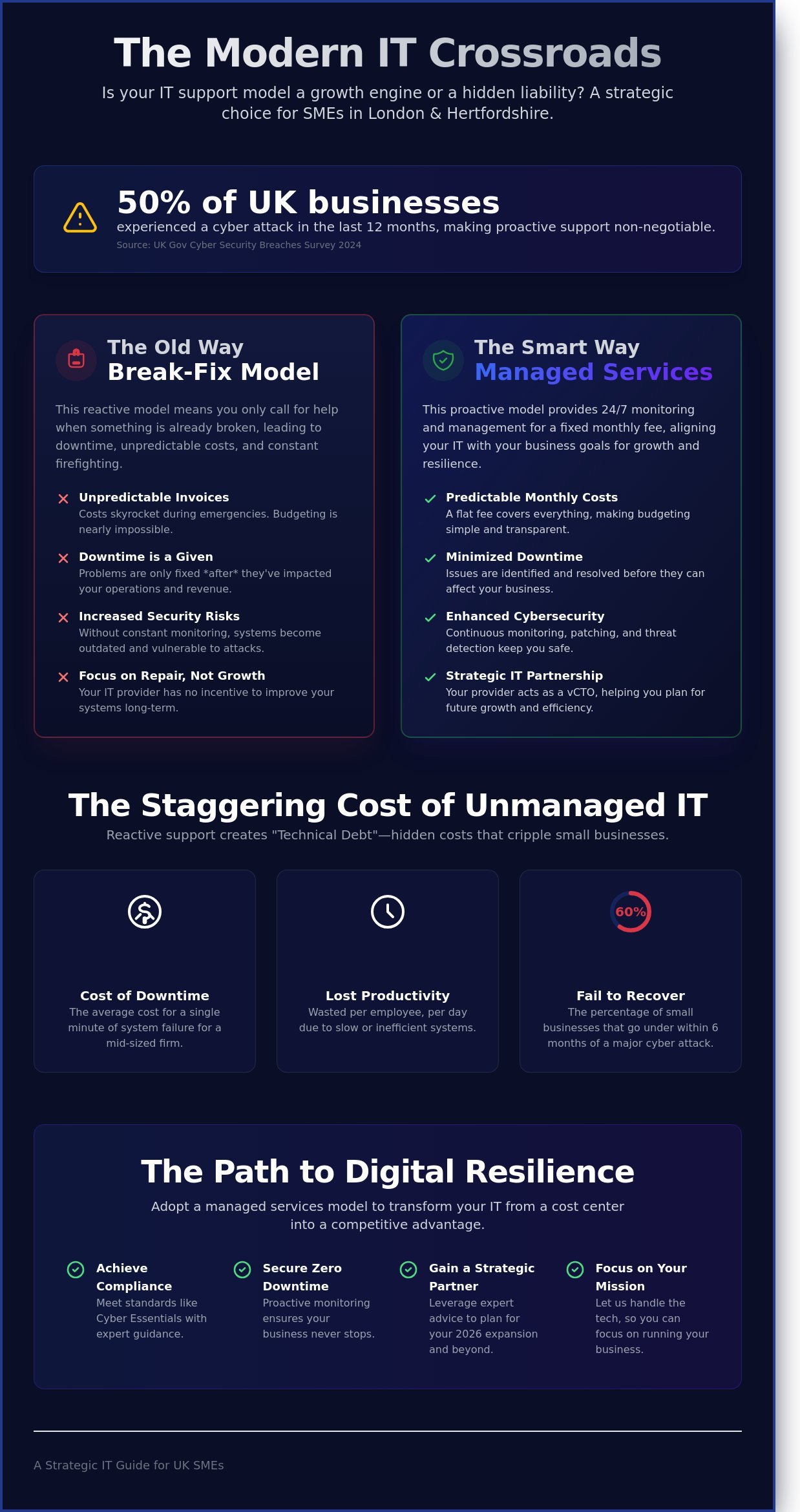
If your firm is one of the 50% of UK businesses that experienced a cyber attack in the last 12 months, according to the government’s Cyber Security Breaches Survey 2024, you already know that “it won’t happen to me” is no longer a viable strategy. You’re likely tired of the endless cycle of reactive fixes and the sudden, unpredictable invoices that follow every technical glitch. It’s common to feel that your organisation is too small for high-level attention from major firms, yet you face the same sophisticated ransomware threats as global corporations.
We agree that your technology should be a silent engine for growth, not a source of daily anxiety. This strategic guide reveals how to implement a small business it support model that moves beyond firefighting to build genuine digital resilience across London and Hertfordshire. You’ll discover the exact steps to achieve Cyber Essentials compliance, secure zero downtime, and move to a predictable monthly billing structure that supports your 2026 expansion plans. We’ll outline a roadmap that transforms your IT from a cost centre into a competitive advantage, giving you the peace of mind to focus on your core mission.
Key Takeaways
- Understand why the “Break-Fix” model is obsolete and how a proactive partnership ensures your technology scales alongside your business growth.
- Compare managed services against traditional repairs to achieve predictable budgeting and enhanced security through professional small business it support.
- Uncover the essential infrastructure requirements for 2026, including how to optimise Microsoft 365 to serve as your firm’s productivity backbone.
- Utilise our expert checklist to identify a trusted IT advisor in the Home Counties who communicates with clarity and focuses on your long-term resilience.
- Learn how to integrate bespoke digital strategy with your existing team to future-proof your operations across London, Hertfordshire, and Buckinghamshire.
The Evolution of Small Business IT Support in 2026
By 2026, the definition of small business it support has shifted from a “helpdesk” function to a core engine of growth. For companies with 5 to 50 employees, waiting for technology to fail before calling an engineer is a strategy for decline. Modern support is a proactive partnership. It integrates cybersecurity, cloud architecture, and business continuity into a single, cohesive framework. The traditional “Break-Fix” model, where you only pay when something stops working, is now obsolete because the pace of digital commerce in London and the Home Counties doesn’t allow for hours of recovery.
Instead, forward-thinking businesses are adopting the Managed Service Provider model to ensure their systems are monitored 24/7. This shift mirrors the rise of hybrid working, which 74% of UK SMEs now offer according to 2025 employment data. Strategic IT means looking beyond the next six months. It involves creating a roadmap that scales as your headcount grows, ensuring your infrastructure is an asset rather than a bottleneck. By aligning your technology with your business goals, you can optimise your operations and maintain a competitive edge.
Small businesses often struggle with the “middle ground” of technology. They’re too large for basic retail support but too small for a full-time in-house IT department. This is where small business it support evolves into a fractional Chief Technology Officer (CTO) role. It’s about resilience and future-proofing your digital assets before they become liabilities.
Why Local Expertise Matters in the Home Counties
Proximity remains a critical factor for business resilience. While remote support solves 95% of software issues, having engineers who can reach sites in London, Hertfordshire, or Buckinghamshire within a 60-minute window is vital for critical hardware failures. Local knowledge of regional ISP reliability, such as specific fibre rollout issues in rural Hertfordshire towns like St Albans or Hemel Hempstead, allows for faster troubleshooting. A partner who understands the Greater London business landscape can better align your tech with local market demands and compliance standards while providing that essential human-centric touch.
The High Cost of Reactive Tech Support
Unmanaged systems create “Technical Debt,” which is the cumulative cost of using outdated hardware or patchwork software solutions. For a typical UK SME, the hidden expenses of downtime are staggering. Research from the Ponemon Institute indicates that the average cost of a single minute of downtime can exceed £4,000 for mid-sized firms. This figure includes more than just the hourly rate of idle staff. It encompasses the long-term damage to your brand reputation and the potential loss of client trust.
- Systemic Fragility: Using consumer-grade routers and unpatched software increases the risk of total system failure.
- Security Gaps: Reactive models often miss critical updates, leaving 60% of small businesses vulnerable to cyberattacks that they cannot recover from financially.
- Operational Drag: Slow systems waste approximately 15 minutes per employee every day, costing a 20-person firm thousands of pounds in lost productivity annually.
Downtime cost is the sum of lost productivity and missed opportunities.
Managed IT Services vs Break-Fix: Which Model Suits Your Business?
Managed IT services act as a strategic insurance policy for your business continuity. While the traditional break-fix model relies on reacting to failures after they’ve already cost you money in downtime, a managed approach prevents the fire from starting in the first place. For directors in London and Hertfordshire, the choice between these models often comes down to risk appetite and financial predictability. A reactive approach might save a few pounds this month, but the cost of a single day of total system failure in 2026 can easily reach thousands of pounds in lost revenue and reputational damage.
A common misconception suggests that comprehensive small business it support through a managed model is reserved for large corporations with massive budgets. This is no longer the case. In reality, a fixed monthly fee provides SMEs with the same level of security and resilience that enterprises enjoy, but at a fraction of the overhead. Proactive monitoring identifies a failing hard drive or a suspicious login attempt at 3:00 AM, long before your team arrives at the office. This transition from “fixing” to “preventing” is what defines a modern, successful business.
The Benefits of a Managed Service Provider (MSP)
Choosing an MSP transforms IT from a fluctuating, unpredictable expense into a manageable utility. You gain 24/7 monitoring and immediate helpdesk access as standard features, ensuring your staff remain productive regardless of the technical challenge. We utilise a transparent per-user or per-device billing structure, which allows you to scale your costs exactly as your headcount grows. This model provides a comprehensive safety net, covering everything from cloud security to hardware maintenance. You can explore our full range of managed IT solutions to see how we protect every layer of your digital infrastructure.
When is Break-Fix Appropriate?
The reactive break-fix model might suffice for a sole trader with minimal digital dependencies, perhaps someone who only requires a basic laptop and an internet connection. However, the risks for any growing company are substantial. Without a contract, you lack guaranteed response times. While a managed client might see a critical issue addressed in under 60 minutes, a break-fix client often waits 48 hours or more for an engineer to become available during peak periods.
Security is the biggest casualty of the reactive approach. Without proactive patching, your systems remain vulnerable to threats that evolve every hour. The UK government cybersecurity guidance emphasises that small firms are frequent targets for automated attacks. Relying on break-fix means you’re only fixing what’s visibly broken, often ignoring the silent vulnerabilities that lead to data breaches. If you want to ensure your operations are truly resilient, it’s time to audit your small business it support needs to identify potential gaps in your current setup.
Essential IT Infrastructure for London and Hertfordshire SMEs
Building a resilient business in 2026 requires more than just functional computers. It demands a cohesive digital foundation that supports growth while shielding you from volatility. For firms operating across London and Hertfordshire, the infrastructure must be agile enough to bridge the gap between a central office and a distributed workforce. This is where strategic small business it support transforms from a technical cost into a competitive advantage.
Microsoft 365 sits at the centre of this ecosystem. It’s no longer a simple suite of office tools; it’s the engine room for identity management and secure collaboration. Proper management ensures that your data remains protected within the cloud while your team utilises AI-driven features to automate routine tasks. We focus on optimising these environments to ensure you aren’t paying for redundant licences you don’t need.
Communication infrastructure has also shifted. Since the UK’s legacy PSTN network was decommissioned, VoIP (Voice over Internet Protocol) phone systems have become the professional standard. These systems allow a boutique firm in St Albans to maintain a prestigious London presence, with calls routed seamlessly to any device. High-quality VoIP ensures you never miss a client enquiry due to technical limitations.
Our proactive approach to hardware support extends the life of your physical assets. By monitoring the health of workstations and servers, we can often extend the lifecycle of a £1,200 laptop by an additional 18 to 24 months. Our comprehensive IT services ensure your hardware remains an asset rather than a liability, preventing the sudden capital expenditure spikes that disrupt cash flow.
Cyber Security: Beyond Antivirus
Basic antivirus software is insufficient in an era of sophisticated phishing and ransomware. We guide our clients through the Cyber Essentials framework, a UK government-backed scheme that protects against 80% of common cyber attacks. By implementing managed firewalls and continuous threat detection, we create a digital perimeter that works 24/7. For a deeper look at protecting your firm, see our Managed IT Support London: The Ultimate SME Guide for 2026.
Data Backup and Disaster Recovery
Data is the lifeblood of your business, yet many SMEs rely on fragile backup routines. We strictly follow the 3-2-1 backup rule: keep three copies of your data, on two different media types, with one copy stored securely off-site. Local backups alone are vulnerable to modern ransomware that specifically hunts for connected backup drives. We provide peace of mind by performing regular, documented recovery drills. This ensures that if the worst happens, your small business it support team can restore your operations in hours, not days.
How to Choose the Right IT Partner in the Home Counties
Selecting a provider for small business it support isn’t just a procurement task; it’s a foundational business decision. You need a “Trusted Advisor” who translates complex technical challenges into clear commercial advantages. Avoid firms that hide behind technical jargon. Instead, prioritise partners who speak plain English and understand that your technology exists to serve your bottom line. A partner who can’t explain a security risk without using acronyms probably doesn’t understand your business goals well enough to protect them.
Reliability in the UK market is built on longevity and proven standards. When you evaluate potential partners, look for these specific indicators of quality:
- 20+ Years of Local Experience: A provider with two decades in the UK market understands the specific infrastructure challenges of London and the Home Counties. They’ve seen every iteration of the digital landscape.
- Microsoft Partner Status: This certification proves the team meets rigorous standards for technical proficiency and customer service. It ensures they’re trained on the latest enterprise-grade tools.
- Strategic Proactivity: They should look over the horizon to identify risks before they become downtime. If they only react when things break, they aren’t a partner; they’re a cost centre.
Questions to Ask Your Potential IT Provider
Don’t accept vague promises of “fast support.” Dig into the metrics that actually impact your daily operations. Ask these specific questions during your consultation:
- “What is your average response time for London-based clients?” Demand data from the last 12 months rather than a theoretical SLA.
- “How do you handle security updates and proactive monitoring?” Look for automated, 24/7 solutions that prevent issues before they reach your desktop.
- “Can you support our transition to hybrid or remote working?” Ensure they have a proven track record with secure cloud collaboration and encrypted remote access.
The Importance of Cultural Fit
Your IT team should feel like an extension of your own staff, not a distant, anonymous helpdesk. A transactional relationship often leads to friction during critical failures. A true partnership model ensures your provider is as invested in your growth as you are. They should know your team’s names and understand your specific workflow requirements. This human-centric approach is vital for small business it support where agility is a competitive advantage.
Deep technical specialisation, such as Expert Microsoft 365 Management, signals that the provider understands the nuances of modern productivity. They don’t just install software; they optimise your environment to ensure your team remains resilient and efficient. This level of care separates a mere vendor from a strategic asset.
Secure your business with a partner that understands the London landscape. Explore our comprehensive managed IT services to see how we can future-proof your operations.
Future-Proofing Your Business with Digit-IT’s Managed Support
Digit-IT acts as a strategic extension of your internal team, serving SMEs across London, Hertfordshire, and Buckinghamshire with a focus on long-term growth. We believe that technology should never be a bottleneck. Instead, it should act as a catalyst for efficiency. Our approach to small business it support moves away from the traditional “break-fix” model, which often leaves companies vulnerable to unexpected costs and downtime. By providing high-level consultancy alongside robust hardware support, we ensure your infrastructure is ready for the demands of 2026 and beyond.
Resilience is built on the foundation of organised digital assets. Many businesses operate with fragmented systems, where “shadow IT” and unmanaged hardware create significant security gaps. According to 2024 industry data, UK businesses that fail to maintain a structured asset registry are 40% more likely to suffer from prolonged recovery times after a system failure. We help you audit, categorise, and secure every component of your digital estate. This structured oversight allows your leadership team to make informed decisions about scaling, rather than reacting to technical emergencies.
Our Proactive Monitoring and 24/7 Support
Effective small business it support should be invisible. We use advanced telemetry to monitor your network 24/7, allowing us to identify and resolve potential hardware failures or software conflicts before they impact your staff. Our focus on seamless operations means your team can remain productive without the frustration of lagging systems or connectivity drops. We prioritise background maintenance that keeps your business running at peak performance. You can view our full range of services to see how we tailor these proactive solutions for growing companies in the South East.
Taking the Next Step: Your Free IT Health Check
Uncertainty is a significant risk in the modern business environment. If you aren’t sure how your current security posture compares to the latest Cyber Essentials standards, a professional audit is the most logical starting point. Our free IT health check identifies hidden vulnerabilities and provides a clear roadmap for improvement. We look past the surface to find the bottlenecks that are quietly draining your productivity. This consultation offers a zero-risk opportunity to gain professional insight into your infrastructure. Contact Digit-IT today for a free IT consultation and discover how a strategic partnership can transform your technology from a cost centre into a competitive advantage.
- Strategic Alignment: We match your IT roadmap to your specific 2026 business goals.
- Asset Management: Full visibility of your hardware and software lifecycle.
- Local Expertise: Dedicated support for firms in London, Hertfordshire, and Buckinghamshire.
- Reduced Downtime: Proactive intervention that stops issues in their tracks.
Choosing the right partner means finding an expert who is invested in your success. We bridge the gap between complex digital tools and human talent, ensuring your technology works for your people, not the other way around. Let us handle the complexities of your infrastructure so you can focus on leading your business forward.
Future-Proof Your Operations for the Next Era of Growth
The transition toward 2026 demands more than just basic troubleshooting; it requires a strategic alignment between your digital tools and commercial objectives. Relying on the outdated break-fix model leaves your company vulnerable to downtime that impacts productivity and growth. By prioritising managed services, businesses in London and Hertfordshire can move away from reactive fire-fighting and focus on sustainable expansion. Modern infrastructure isn’t just a utility, it’s the engine of your competitive advantage.
Digit-IT leverages over 20 years of SME technical expertise to deliver high-level small business it support that acts as a natural extension of your internal team. We provide 24/7 proactive monitoring to identify and resolve vulnerabilities before they impact your daily workflow. Our specialists possess deep knowledge of the specific operational needs within the Home Counties, ensuring your technology remains compliant and agile. It’s time to stop worrying about your systems and start leveraging them for success.
Secure your business future with a free IT health check from Digit-IT
We’re ready to help you navigate the complexities of the modern digital landscape with total peace of mind.
Frequently Asked Questions
How much does small business IT support cost in the UK?
Small business IT support in the UK typically costs between £35 and £150 per user, per month, based on 2025 industry benchmarks. This pricing varies depending on the complexity of your infrastructure and the level of proactive monitoring required. We focus on delivering a transparent investment model that aligns with your growth strategy, ensuring you only pay for the specific resilience and security your operations demand.
What is the difference between remote and on-site IT support?
Remote support involves resolving technical issues via secure digital access, while on-site support requires an engineer to visit your physical premises in London or Hertfordshire. Remote interventions resolve 92 percent of daily technical hitches within minutes. On-site visits are reserved for hardware failures or complex infrastructure optimisations that require a physical presence to ensure total business continuity.
Does my small business really need managed cyber security?
Yes, because 50 percent of UK businesses identified a cyber attack in the 2024 Cyber Security Breaches Survey. Managed security isn’t just an optional extra; it’s a fundamental layer of your business strategy. We implement proactive defences that protect your reputation and financial assets from evolving threats, ensuring your digital infrastructure remains resilient against sophisticated modern exploits.
Can you support my business if some staff work from home in Hertfordshire?
We provide seamless support for your remote workforce across Hertfordshire using secure VPNs and cloud-based management tools. Our team ensures that staff working from home in St Albans or Watford experience the same level of connectivity and security as those in the office. This unified approach eliminates technical silos and maintains high productivity levels regardless of your team’s physical location.
What happens if our server goes down in the middle of the night?
Our 24/7 proactive monitoring systems detect and alert our engineers to server failures the moment they occur, even at 3:00 am. We often resolve these critical issues before your staff start their working day. This automated vigilance minimises downtime and ensures your operations remain stable, providing the peace of mind you need to focus on your core business objectives.
How quickly can an engineer get to my office in London or Buckinghamshire?
An engineer can typically reach your office in London or Buckinghamshire within two to four hours for critical hardware emergencies. We maintain a local presence to ensure rapid physical intervention when remote tools aren’t enough. For non-urgent requests, our service level agreements guarantee a response within a specific timeframe tailored to your unique small business IT support requirements.
Is Microsoft 365 management included in managed IT support?
Microsoft 365 management is a core component of our comprehensive small business IT support packages. We don’t just set up accounts; we optimise your entire tenant for security and collaboration. This includes managing user permissions, implementing multi-factor authentication, and ensuring your cloud data is backed up according to UK data protection standards to ensure long-term digital resilience.

